Exterior waterproofing stops water before it ever reaches your foundation wall - which is why it's the closest thing to a permanent fix in basement waterproofing. It's also the more disruptive, more expensive option, which is exactly why it's worth understanding what the process actually involves before deciding it's the right call for your home.
How Exterior Waterproofing Actually Works
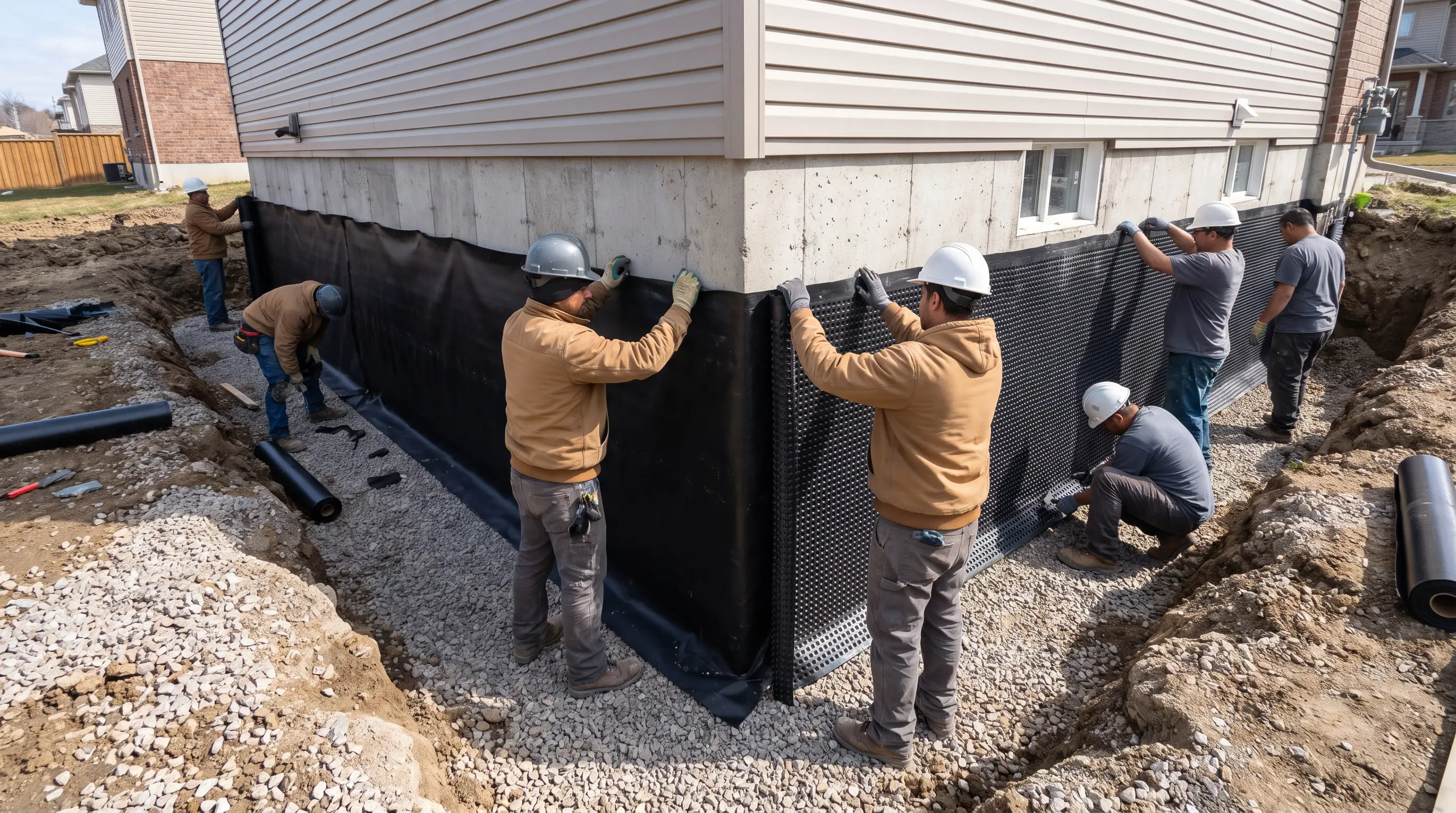
The process starts with excavation - digging down along the foundation wall to the level of the footing, exposing the entire wall face from grade to base. Once exposed, the wall gets cleaned and inspected, any cracks or deteriorated sections get repaired, and a waterproof membrane (typically a rubberized asphalt or crystalline coating) is applied directly to the concrete. A dimpled drainage board goes over the membrane, creating an air gap that lets any residual moisture drain freely instead of pressing against the wall. New weeping tile is installed at the base, sloped toward a discharge point well away from the house, and the trench gets backfilled with clean gravel to keep the whole system draining properly for decades.
Access for the excavation equipment is part of the planning conversation before any digging starts. A backyard with wide side-yard access and no mature landscaping close to the foundation is the simplest scenario - a mini-excavator can work efficiently with minimal manual digging. A tight urban lot, a foundation crowded by a deck or patio, or landscaping the homeowner wants preserved as much as possible sometimes means more of the work happens by hand, which adds time and labour cost but keeps the disruption more contained to the specific area being addressed. This access assessment happens during the same visit where entry points get diagnosed, so the proposal already reflects the realistic equipment and labour mix for your specific property rather than a generic assumption applied to every job.
The core advantage: because the work happens on the outside of the wall, it stops water before it ever contacts the foundation - and it lets crews inspect and repair the actual wall condition while it's fully exposed, catching problems an interior-only approach would never see.
Exterior vs. Interior: The Real Trade-Off
Exterior Waterproofing
Stops water at the source, lets crews inspect and repair the wall itself, and is genuinely built to outlast interior systems. The trade-off: full excavation disrupts landscaping and costs meaningfully more.
Interior Drainage
Lower cost, no excavation, installable any season. The trade-off: it manages water after it enters rather than stopping it at the wall, and the wall's actual condition stays hidden.
When Exterior Is Genuinely Worth the Extra Cost
Exterior waterproofing earns its higher price tag in specific situations rather than being the automatic upgrade for every water problem. It's the right call when the existing exterior weeping tile has failed outright - common in Hamilton homes built before 1980, where clay tile has silted up or collapsed over decades. It's also the right call when there's reason to suspect the foundation wall itself has cracks or deterioration that need direct inspection and repair, since interior drainage never actually exposes the wall to check. And it's worth it when a homeowner wants the most complete, lowest-maintenance solution available and is planning to stay in the home long enough to value a system built for 30-plus years over a lower upfront cost.
It's less clearly worth it when the water entry pattern is diffuse seepage through an otherwise sound wall, or when landscaping constraints make excavation genuinely impractical - both situations where interior drainage solves the actual problem at a fraction of the disruption and cost.
Home resale timing is another factor worth weighing honestly. If you're planning to sell within a couple of years, the lower-cost interior fix that solves the visible symptom may deliver more practical value than a full exterior investment you won't be around long enough to fully benefit from - though a documented exterior waterproofing system with a transferable warranty can also be a meaningful selling point, depending on your local market and how water problems in the area are generally perceived by buyers.
What Crews Often Find Once the Wall Is Exposed
One of the underrated benefits of exterior excavation is what it reveals that no interior inspection ever could, and it's part of the value proposition that a headline price comparison against interior drainage often misses entirely. Hairline cracks below grade, sections of parging that have separated from the wall, honeycombing in older poured concrete, or a footing that's settled slightly unevenly - all of these are invisible from inside the basement but show up the moment the wall is exposed. On a meaningful share of Hamilton projects, the excavation turns up at least one issue the homeowner didn't know they had, and because the wall is already open, addressing it costs a fraction of what a dedicated repair project would cost later. This is part of why exterior work, despite the higher upfront price, often represents better long-term value than its sticker price alone suggests - you're not just buying a membrane, you're buying a full inspection and repair of the wall itself.
Membrane Types: What Actually Goes on the Wall
Not all exterior membranes are the same, and the choice matters for longevity, so it's worth understanding the trade-off rather than assuming every waterproofing quote is describing the same product. A rubberized asphalt membrane, sprayed or trowel-applied, is the most common choice for residential foundations - flexible enough to bridge minor hairline cracks that develop after application, and reliable for decades when installed at the correct thickness. A crystalline waterproofing coating works differently, chemically reacting with the concrete to form crystals that fill capillary pores within the concrete itself, which some engineers consider more permanent since it becomes part of the wall rather than sitting on top of it. Both are valid choices; the right one depends on the wall's condition, budget, and what the assessment finds once the excavation is underway. Either way, the drainage board and new weeping tile that follow are just as important as the membrane itself - a great membrane with no drainage board or failed weeping tile behind it still leaves hydrostatic pressure building against the wall over time.
What Exterior Waterproofing Costs in Hamilton
$15,000 - $25,000: Partial Perimeter
Excavation and membrane along one affected wall section, typical for a localized problem area identified during assessment.
$25,000 - $40,000: Full Perimeter
Complete excavation and waterproofing around the entire foundation, for homes with widespread failure of the original exterior system.
Foundation depth, soil conditions, and site access are what move a specific quote within that range. Full method and pricing details are on our exterior waterproofing service page.
It's worth noting that these figures already include the membrane, drainage board, new weeping tile, excavation, and standard backfill - not a stripped-down base price with major components quoted as add-ons afterward. The only common addition beyond this range is full landscaping restoration beyond basic backfill and grading, which gets priced separately since it varies so widely by what a homeowner actually wants replaced.
Signs Exterior Waterproofing Is the Right Fit
For a real example of exterior waterproofing from start to finish, see our exterior waterproofing case study, and if you're ready to get a number for your own home, our free estimate guide covers what that visit includes.
Frequently Asked Questions
Because it stops water before it ever touches the foundation wall, rather than managing water after it has already passed through. A properly installed exterior membrane and drainage system addresses the source of the problem, which is why it's the more comprehensive - though more disruptive - option.
Most single-wall or partial-perimeter projects take 3 to 7 days depending on excavation depth, access, and how much of the perimeter is affected. Full-perimeter excavation on a larger home can take longer.
The excavated area is backfilled and the surface restored as part of the standard scope, though full landscaping restoration - replacing plants, sod, or hardscaping - is typically quoted separately if you want more than basic backfill and grading.