A basement doesn't fail overnight. It sends warning signs first - a crack that widens, a musty smell that won't go away, a door that suddenly sticks - and how you respond to those signs decides whether you're looking at a $500 repair or a $60,000 one. Here's how to read the signs your Hamilton basement is actually showing you, and which ones mean pick up the phone today.
Signs That Are Usually Just Cosmetic
Not every mark on a basement wall is an emergency. Hairline vertical cracks under 3mm wide, especially ones that appear near the centre of a poured concrete wall within the first year or two after the home was built, are typically shrinkage cracks from the concrete curing. They're worth noting and monitoring, but they rarely indicate a structural problem on their own.
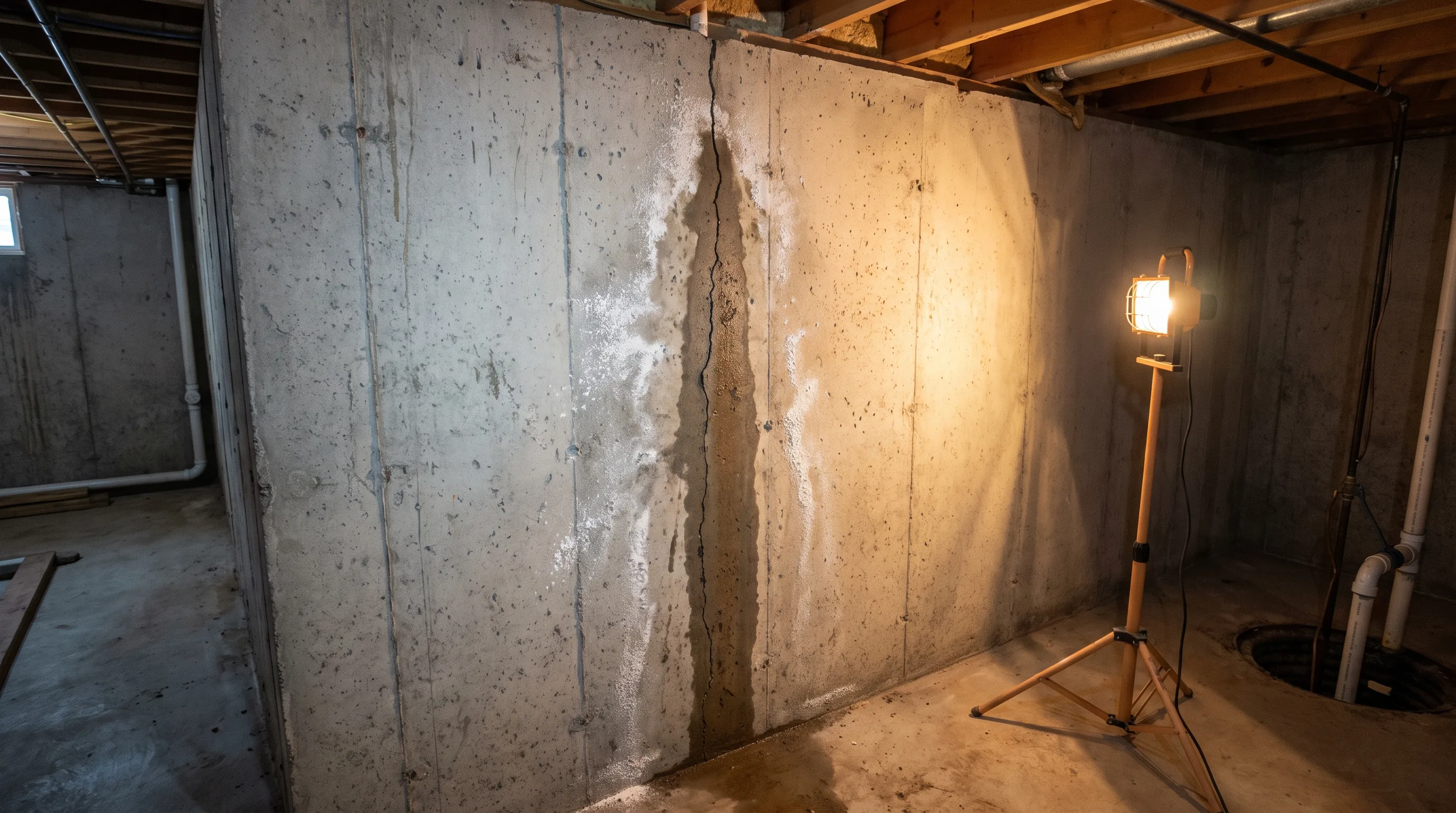
Efflorescence - that white, chalky powder that shows up on basement walls - is also cosmetic on its own. It's mineral deposits left behind as water moves through concrete and evaporates. It doesn't mean the wall is failing, but it does confirm that moisture is passing through somewhere, which is worth tracking if it keeps reappearing in the same spot.
The rule of thumb: a single hairline crack with no water and no movement is worth watching. Two or more warning signs together, or any sign that's getting worse month over month, is worth a professional look.
Moisture Signs That Point to a Water Entry Problem
Hamilton sits on clay-heavy soil that holds water and swells against foundation walls after rain - a condition called hydrostatic pressure. Combined with the city's freeze-thaw winters, that pressure finds any weak point in a foundation and pushes water through it. Watch for these specific patterns:
- Water that appears at the same spot on the floor or wall after every heavy rain, rather than randomly
- A musty smell that returns even after cleaning, especially near the rim joist or along the base of a wall
- Rust stains or discoloration streaking down from a crack, which usually means water has been tracking through it repeatedly
- Standing water pooling along the perimeter of the floor, particularly after spring thaw or a multi-day rain event
- A sump pump that runs constantly, or one that never seems to run at all despite a known wet basement
Any one of these points to an active water entry point - not condensation, not humidity, an actual path where groundwater is getting in. That's a job for basement waterproofing, not a dehumidifier.
Structural Signs That Need Immediate Attention
These are the signs that separate a waterproofing job from a foundation repair job, and they should never be left for "next spring":
- Horizontal cracks running across a poured concrete wall, especially at mid-height - these indicate the wall is being pushed inward by soil pressure
- Stair-step cracks following the mortar joints in a block foundation - a strong indicator of settlement or lateral movement
- Any crack wider than 3mm, or one that's visibly widened since you first noticed it
- A wall that bows or leans inward when checked with a straightedge or level
- Doors and windows on the main floor that have started sticking or no longer close square in their frames
- Sloping or bouncing floors directly above the basement
A bowing wall in particular doesn't stabilize on its own. It's losing its ability to resist the soil pressure behind it, and left alone it typically continues moving until it requires far more extensive - and expensive - foundation repair to correct.
Interior vs. Exterior Waterproofing: Which Fixes Which Sign
Interior Drainage - For Water Entering Through the Wall
A drainage channel installed at the base of the interior foundation wall intercepts water before it reaches the floor, routes it to a sump pump, and discharges it safely away from the home. Less disruptive, installable year-round, and the right fix for most active leaks. $8,000 to $20,000 for a full perimeter system.
Exterior Waterproofing - For Stopping Water at the Source
A waterproof membrane applied directly to the outside of the foundation wall after excavation stops hydrostatic pressure before it ever reaches the concrete. More complete, but requires excavating around the perimeter. $15,000 to $40,000 depending on depth and access.
What Happens If You Ignore These Signs
Hamilton's freeze-thaw cycle doesn't pause for a homeowner who wants to wait until spring. A 2mm crack that goes unaddressed can widen to 8mm within three years as water enters, freezes, expands, and forces the crack open further each winter. What starts as a $500 to $2,000 crack injection can escalate into $3,000 to $8,000 in carbon fibre wall reinforcement, and in the most neglected cases, tens of thousands in full underpinning to correct settlement that a $1,500 repair could have prevented years earlier.
Water damage compounds the cost further - mould remediation, damaged flooring, ruined storage, and in older homes, degraded framing above the affected wall. The math almost always favours addressing a sign early over waiting to see if it gets worse.
What a Professional Assessment Actually Checks
When BaseWorks comes out for a free assessment, we're not just looking at the crack or the damp spot you called about. A proper assessment covers the whole picture:
- Every foundation wall, inside and where accessible outside, checked for cracking, bowing, and moisture staining
- Grading around the home's perimeter to see whether surface water is being directed toward the foundation
- The condition and function of existing weeping tile and sump pump equipment, where present
- Floor and wall alignment checked with a level to catch movement that isn't visible to the eye
- A straightforward explanation of what we found, what it means, and what it will cost to fix - in writing, same visit when possible
What Basement Waterproofing Costs in Hamilton
Costs scale with the scope of the problem, not a flat rate per house. Crack injection alone runs $500 to $2,000 per crack. A full interior drainage system runs $8,000 to $20,000. Exterior waterproofing with excavation runs $15,000 to $40,000 depending on foundation depth and accessibility. BaseWorks writes every quote fixed-price after the free assessment, and interior drainage installs typically don't require a City of Hamilton permit, while exterior work involving deeper excavation may. Full details are on our basement waterproofing service page.
Common Misconceptions About Basement Warning Signs
A few beliefs we hear often at the assessment stage end up costing homeowners time they didn't need to lose. The first is that painting over a damp wall with a "waterproof" basement paint solves the problem - it doesn't. Those coatings can trap moisture inside the concrete, sometimes making the underlying deterioration worse even as the visible dampness disappears for a while.
The second is that a dehumidifier fixes any basement moisture issue. A dehumidifier manages humidity in the air; it does nothing for water actively entering through a crack or wall. If the dehumidifier's reservoir keeps filling faster than seems normal, or your basement stays damp even when it's running constantly, that's usually a sign of active water entry, not just humid air.
The third is that a new home means a new foundation is immune to these problems. Newer Hamilton subdivisions built on clay-heavy soil can show water entry signs within the first decade if grading or weeping tile wasn't installed to spec - age isn't a reliable predictor of risk on its own.
Is It Time to Call a Professional?
Frequently Asked Questions
Thin vertical cracks under 3mm wide, especially near the middle of a poured concrete wall, are usually shrinkage cracks from curing and are common in Hamilton homes. Horizontal cracks, stair-step cracks in block foundations, or any crack wider than 3mm are a different story and warrant a professional assessment.
Not always. Condensation from humidity is common and usually solved with a dehumidifier. But water that appears at the same spot after every heavy rain, or that pools along a wall, points to a water entry point that a dehumidifier can't fix - that's a waterproofing issue.
No. A bowing or inward-leaning wall is a structural warning sign regardless of whether water is present. Bowing means the wall is losing its ability to resist soil pressure, and it typically gets worse - not better - without reinforcement or underpinning.
It depends entirely on the sign. Crack injection runs $500 to $2,000 per crack. Interior drainage systems run $8,000 to $20,000. Exterior waterproofing with excavation runs $15,000 to $40,000. A free assessment identifies which of these your home actually needs before any number gets quoted.
Usually not for gradual issues like groundwater seepage or settling cracks - most policies treat this as a maintenance issue, not a covered peril. Sudden events like a burst pipe or sewer backup may be covered depending on your policy. Confirm with your insurer before assuming coverage either way.