Every foundation crack tells a different story. BaseWorks reads what each one actually means structurally, picks the injection material that fits, and seals it for good - fixed-price, no upselling to a bigger job than you need.
UNDERSTANDING CRACKS
Real crack repair starts with correctly reading the crack in front of you. Direction, width, location, and moisture all tell a different structural story. A vertical crack running top to bottom in poured concrete with no lateral offset is usually just a shrinkage crack from curing - common, low urgency, worth sealing to keep water out but not alarming. A horizontal crack in a block wall is an entirely different situation: that's bending stress from lateral soil pressure, and it needs a structural engineer's eyes on it.
Every project gets a hands-on assessment before we recommend a single thing. We measure crack width at multiple points, check for lateral displacement, probe for moisture, and look at the crack's history if you can tell us anything about it. Only after that do we decide whether injection alone is enough, or whether it needs structural reinforcement alongside it.
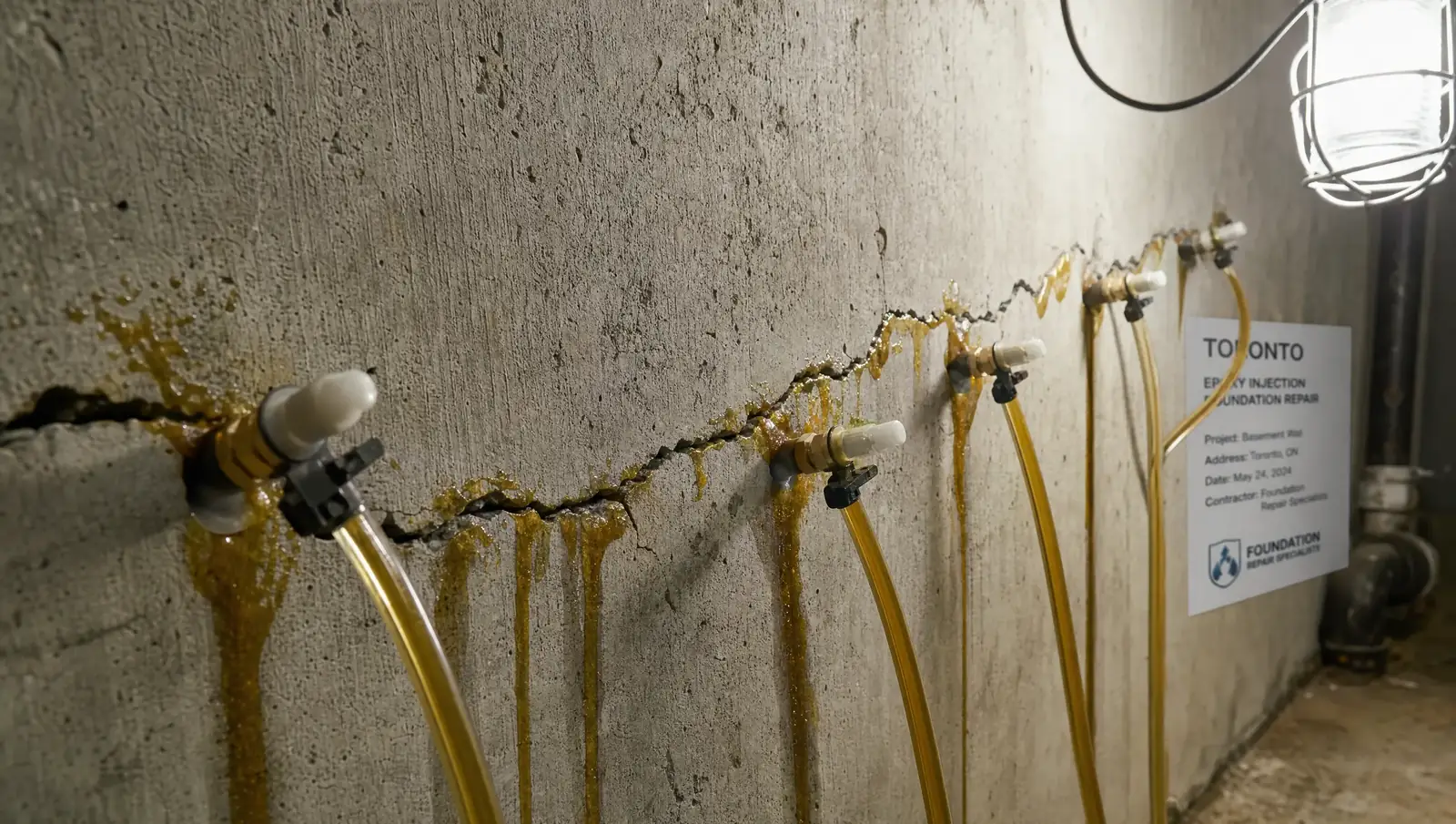
Epoxy injection ports installed along a diagonal poured concrete crack in a Waterdown semi-detached home.
Matched to the right crack, injection repair is a genuinely permanent fix - clean, done in a single day, with no structural disruption to the rest of the wall.
PRICING
Pricing depends on the crack's length, width, access, and which material the job calls for. Most injection repairs are priced per crack and wrapped up in a single appointment.
We won't quote crack repair over the phone. An accurate number requires seeing the crack in person, since width, length, interior or exterior access, and moisture condition all move the price. Our written fixed-price quotes cover labour, materials, and surface preparation, full stop.
COMMON QUESTIONS
What Hamilton homeowners ask most before booking crack injection.
Repair is warranted for horizontal cracks (always a structural concern), anything wider than 3mm, actively leaking cracks, stair-step cracking in block or brick walls, and any crack that's measurably grown. Hairline shrinkage cracks under 1mm in poured concrete are generally low priority and fine to monitor for now.
Epoxy restores structural bond across the crack, curing as strong as or stronger than the original concrete - the right choice for dry cracks in structural walls. Polyurethane expands to fill and seal wet or actively leaking cracks, creating a watertight barrier without restoring structural strength. We pick whichever material actually matches your crack's condition.
Most appointments run 2 to 6 hours per crack, depending on length, width, and access, with injection ports going in roughly every 8 to 12 inches. Cure time is 24 to 48 hours. Polyurethane seals watertight within hours; epoxy reaches full structural strength in that same 24-to-48-hour window.
In most cases, no - injection repair is a material fix to an existing element and doesn't trigger a City of Hamilton building permit. If it's part of a larger structural project, that broader project may require one. We'll flag whatever applies during the assessment.
A properly injected crack is permanently sealed. What can happen is a new crack forming near the original repair if the underlying cause - soil pressure, water pressure, settlement - never got addressed. We identify and flag root causes alongside every crack repair specifically to prevent that.
Typically $500 to $2,000 per crack, depending on length and access. Every quote is written and fixed-price, provided after a free assessment, covering labour, materials, and surface preparation - no hidden costs added later.
Our foundation crack repair Hamilton crews cover the whole city, with no travel surcharge anywhere in our service footprint.
Tell us where it is, which direction it runs, and roughly how big. We'll assess it in person and give you a straight answer on what it actually means and what to do next.