A 1960s split-level in Chedoke came to us with a diagonal crack running across the foundation wall near a corner, first noticed during a routine gutter cleaning. The homeowners had no idea how long it had been there or whether it was getting worse, which is a common and reasonable source of anxiety when you find a crack you can't date. This is a walkthrough of that project, from the first inspection through the engineering assessment to the finished epoxy repair.
The Problem
The crack ran diagonally from a corner of the foundation wall, roughly about 30 inches long, with a hairline width that varied slightly along its length - narrower at the top, marginally wider toward the bottom. Diagonal cracks near corners are a recognized pattern for differential settlement, where one part of the foundation has settled slightly more than an adjacent section, and this one fit that pattern closely enough to warrant a closer look before committing to a repair method.
The house itself was a mid-century split-level, built in the early 1960s on a lot with a modest grade change from front to back. That kind of grade variation is common throughout Chedoke, and it's exactly the condition that tends to produce differential settlement decades after a house is built, as soil beneath different parts of the foundation compacts and shifts at slightly different rates over the years, sometimes long after the original owners have moved on.
Why we didn't just inject it: a diagonal crack near a corner can mean the foundation is still settling. Injecting before confirming that would risk sealing a crack that reopens somewhere nearby once the underlying ground movement eventually continues.
The Engineering Assessment
A structural engineer carefully measured the crack's width at several points, checked for any recent change using comparison photos the homeowners had taken a year earlier, and evaluated the soil and drainage conditions around that corner of the house. The comparison photos were the key piece of evidence - the crack's width hadn't changed measurably over that year, which indicated the settlement causing it had already stabilized rather than being an ongoing, active process.
The engineer also checked the interior side of the wall for any corresponding signs of movement - drywall cracking near the corner, door frames out of square, or flooring separation - none of which were present anywhere in the finished living space above. That absence of secondary symptoms reinforced the read that this was an isolated, historical settlement event rather than an active, worsening condition still affecting the structure above.
Engineering Confirmation
Settlement had occurred but stabilized - no further movement measured against a year-old photo baseline, clearing the crack for injection-only repair.
Epoxy Injection
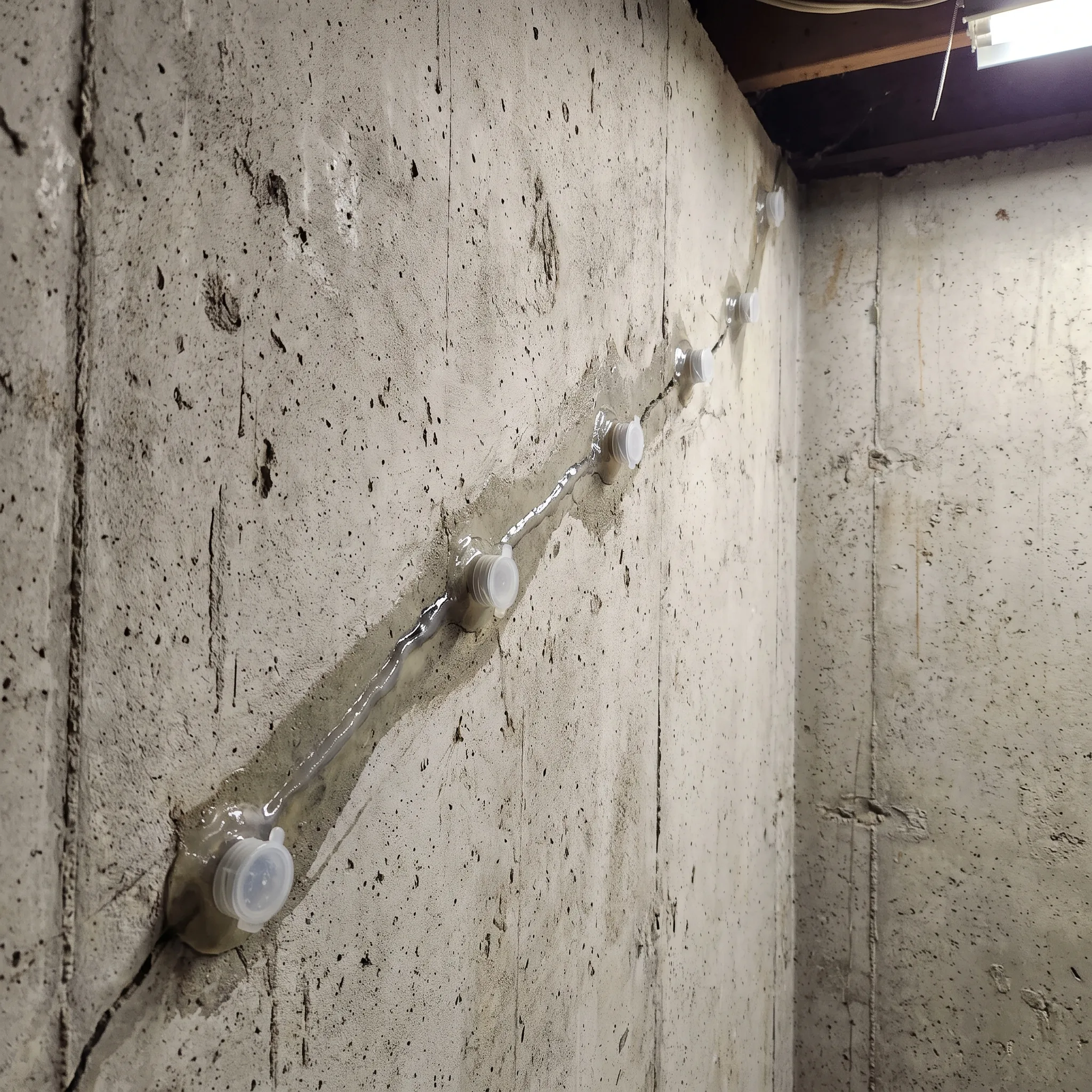
Since the crack was dry and the settlement had stopped, epoxy was specified to restore structural bond strength across the full 30-inch length precisely.
The Repair Process
The appointment ran about 4 hours. Injection ports went in roughly every 8 inches along the crack's diagonal length - closer together than a typical vertical crack because of the slightly varying width. Epoxy paste sealed the crack face between ports, then epoxy resin was injected at low pressure through each port in sequence, starting from the bottom of the crack and working upward. Once every port was filled and capped, the surface was cleaned and the repair left to cure. We also recommended re-grading the small area near that corner, where soil had settled slightly toward the foundation rather than away from it - a minor contributing factor worth correcting alongside the crack itself.
One additional step on this particular job: because the crack sat close to a corner, we also inspected the adjacent wall section for any related hairline cracking that might not have been immediately visible under normal lighting. None was found, which supported the engineer's read that this was a contained, stabilized settlement event rather than something spreading further along the foundation.
The Result
- The full 30-inch crack filled and structurally bonded, confirmed by a post-cure inspection at 48 hours
- No further movement detected in follow-up monitoring over the following two months
- Grading correction completed the same visit, reducing water pooling near the repaired corner
- Total timeline: about 10 days from first call to finished repair, most of it spent scheduling the engineering assessment
- A written engineering report on file documenting that the settlement had fully stabilized before repair began
The homeowners now have documentation confirming the settlement had stabilized before any repair was performed - useful both for their own peace of mind and for a future sale disclosure. For pricing and process details on a similar repair, see our foundation crack repair service page, or read our full epoxy injection guide if you're trying to understand what your own crack means.
Why Those Year-Old Photos Really Mattered So Much
The homeowners had taken the comparison photos for an unrelated reason - documenting the exterior for a landscaping project - and had no idea they'd become the single most useful piece of evidence in diagnosing their foundation crack a year later. Without that baseline, the engineer would have had to make a judgment call based on a single point-in-time inspection, which is a far less certain basis for clearing a crack for injection-only repair. It's a detail worth mentioning to any Hamilton homeowner: if you ever photograph your foundation for any reason, keep those photos somewhere you can find them again. They can end up mattering more than you'd expect years down the line.
Why Chedoke's Older Housing Stock Often Sees This Exact Pattern
Chedoke sits along the escarpment's lower slopes, and a lot of the neighbourhood's mid-century split-levels and bungalows were built on lots with more grade variation than a typical flat-lot subdivision. That grade variation means foundations in the area sometimes experience more differential settlement - uneven settling between one section of the foundation and another - than homes built on more uniform terrain. It's not a defect specific to any one house; it's a function of the land itself. Homeowners in Chedoke and similarly graded parts of Hamilton are, in our experience, more likely to see diagonal cracks near corners specifically because of this pattern, which is exactly why the engineering step matters more here than it might on a flat-lot subdivision home elsewhere in the city.
What Would Have Happened If the Settlement Hadn't Actually Stabilized
Had the engineer instead found evidence of ongoing settlement rather than a stabilized crack, the repair plan would have looked quite different. Epoxy injection on an actively settling crack risks the epoxy bond itself cracking again as the foundation continues moving, which would waste the repair cost and leave the homeowner back where they started, having paid for a repair that didn't hold. In that scenario, the recommendation would likely have included monitoring the crack for a defined period, addressing any grading or drainage issue contributing to the settlement, and potentially underpinning that section of foundation if the movement was significant enough. The Chedoke homeowners were fortunate that a year of stability meant a much simpler and less expensive path forward.
Lessons for Other Hamilton Area Homeowners
If you're seeing something similar on your own foundation, our free assessment guide walks through what that first visit covers.
Frequently Asked Questions
The crack ran diagonally with early signs of differential settlement, which meant epoxy injection alone might have sealed the crack without addressing why the foundation was settling unevenly in the first place.
The crack was dry with no active water intrusion, and the priority was restoring structural bond strength rather than stopping a leak. Epoxy cures as strong as or stronger than the original concrete, which was the right fit once the engineer confirmed no further settlement was expected.
The engineering assessment took about a week to schedule and complete. Once cleared for injection alone, the repair itself was finished in a single 4-hour appointment, with the epoxy reaching full strength within 48 hours.