A 1950s bungalow in Landsdale came to us with chronic basement dampness the family had been managing with a dehumidifier for three years, until a wet spring finally pushed water across the floor. This is the full walkthrough of that project: why interior drainage alone wasn't enough, what the exterior work involved, and the final cost, including the decisions that kept the project from becoming a full-perimeter excavation.
The Problem
The homeowners had lived with a persistently damp basement since buying the house, treating it as a maintenance nuisance rather than a structural issue - running a dehumidifier constantly and avoiding storing anything directly on the floor. That changed after a particularly wet spring, when water began appearing across a section of the floor after every significant rainfall, well beyond what the dehumidifier could manage.
The assessment found active seepage along two wall sections, efflorescence staining extending well above the floor line, and - once a section of yard was probed - a original clay weeping tile system that had almost fully collapsed and silted in over seven decades. Interior drainage would have collected and managed the water that got in, but it wouldn't have addressed the failed exterior tile or the ongoing wall seepage itself. The probe also confirmed the grading along that elevation sloped gently toward the house rather than away from it, a secondary contributing factor that got corrected as part of the final landscaping restoration.
Why exterior was the right call here: when the original weeping tile has failed and water is entering through the walls themselves, not just the floor-wall joint, exterior work is what actually stops the problem rather than just managing its symptoms.
The Cost Breakdown
Exterior Excavation & Membrane: $19,800
Excavation to footing depth along the affected elevation, new waterproof membrane, drainage board, and replacement weeping tile connected to a new discharge point.
Interior Sump Tie-In: $4,600
A partial interior drainage connection and new sump pump to handle the water the new exterior system now redirects.
Landscaping restoration and final grading correction added $3,000, bringing the total to $27,400 - within the typical exterior waterproofing range given the foundation depth and Hamilton's clay soil conditions on this lot. See our basement waterproofing service page for the full pricing breakdown this project fits into.
What the Exterior Work Actually Involved
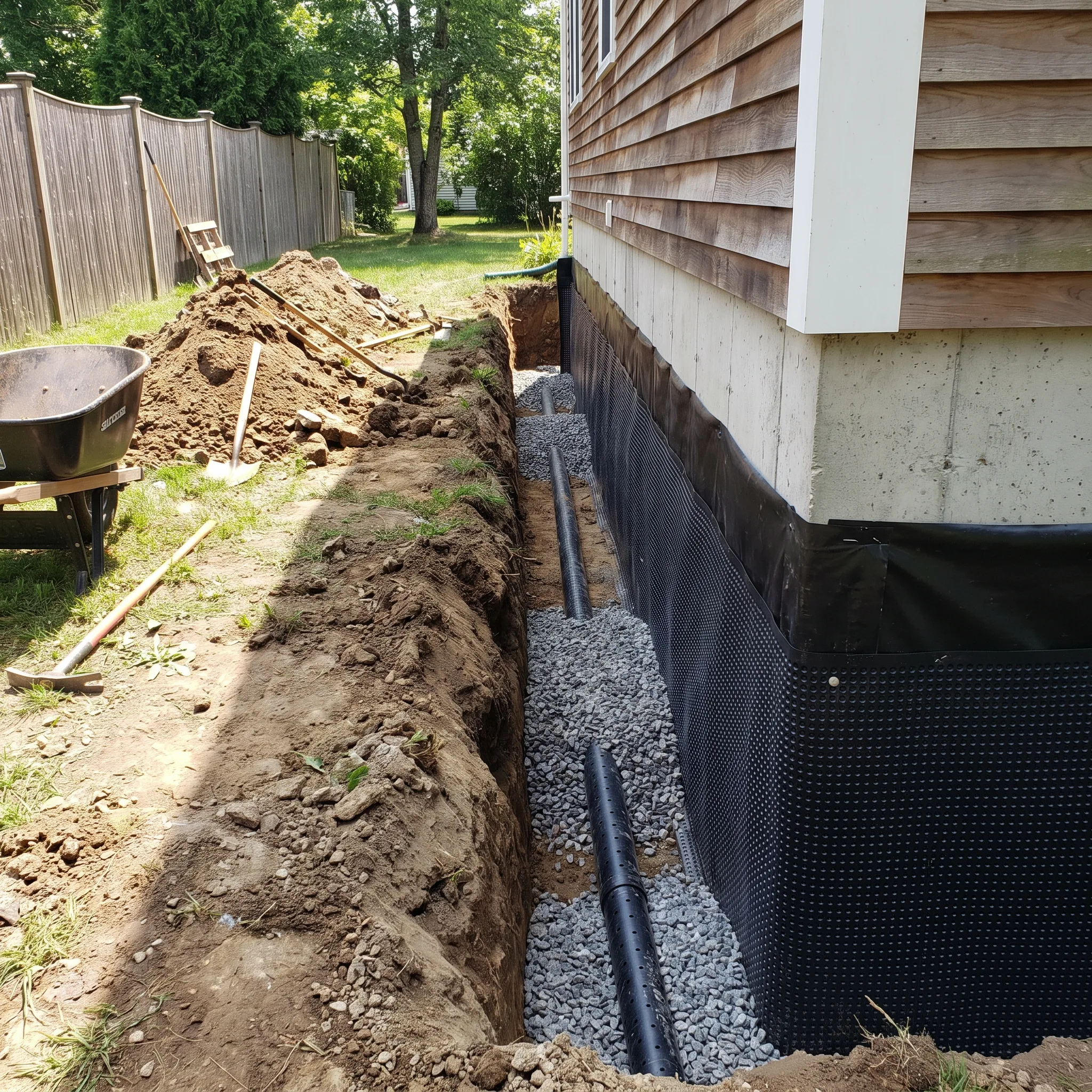
Excavation ran along the single affected elevation down to the footing, exposing the full foundation wall. The old, cracked parging was removed, the wall surface cleaned and inspected for any structural cracks needing injection first, then the new waterproof membrane was applied and protected with drainage board before backfilling. New weeping tile went in at the footing level, connected through to the new interior sump pump rather than tying into the old, collapsed clay system.
One detail that mattered on this project: rather than excavating the entire perimeter, the assessment identified that only one elevation was actually showing active seepage, with the other three walls in reasonably sound condition. Limiting the exterior scope to the affected wall alone - rather than defaulting to a full-perimeter excavation - kept the project meaningfully smaller and less expensive than it would have been otherwise, without compromising the fix. This is exactly the kind of judgment call that a proper assessment makes possible and a sight-unseen quote can't.
Landscaping along the excavated side - a garden bed and a section of fence - was removed before work began and restored once backfilling and grading were complete. The family used the rest of the yard normally throughout the three-week exterior phase, and interior life continued uninterrupted since none of the work touched the inside of the house beyond the final sump connection.
The homeowners had specifically asked whether the garden bed's mature perennials could be preserved rather than removed outright, and the crew worked with them to temporarily relocate the plants to a holding area in the yard before excavation began, replanting them once backfilling was complete. It's a small detail, but one that mattered to the family and is the kind of accommodation a locally run crew can make that a larger, less flexible operation sometimes can't.
The Result
- Zero water intrusion through two full rainy seasons following completion, including a storm comparable to the one that originally prompted the call
- New weeping tile and membrane replacing a collapsed 70-year-old clay system
- New sump pump with battery backup added for storm-related power outage protection
- 10-year warranty on the drainage installation, with landscaping fully restored
- Grading correction along the affected elevation, removing a secondary contributing factor identified during the assessment
The family's dehumidifier now runs only occasionally for general humidity rather than constantly fighting active water intrusion. If your basement has a similar long-standing dampness issue, our free assessment guide walks through what that first visit actually covers.
Why the Homeowners Waited Three Years Before Calling
The family told us afterward that the dehumidifier felt like it was "handling it" for long enough that the problem never seemed urgent - until it clearly wasn't handling it anymore. This is a pattern we see often: a manageable symptom gets treated as the actual fix, and the underlying cause (in this case a collapsing 70-year-old weeping tile system) keeps deteriorating in the background the entire time. By the time water was visibly crossing the floor, the tile had likely been failing for years already; the dehumidifier had simply been keeping pace with a slowly worsening problem until it finally couldn't anymore.
In hindsight, the homeowners said they wished they'd had a professional assessment done in year one, when the dampness first appeared, rather than waiting for a dramatic failure to prompt the call. An early assessment likely would have caught the tile's condition before it fully collapsed, potentially allowing a smaller, less expensive intervention than the full exterior excavation this project eventually required.
Why Landsdale's 1950s Housing Stock Sees This Often
Landsdale's post-war bungalows and small two-storeys, most built in the 1950s and early 1960s, sit right at the edge of when clay weeping tile was still standard before plastic and PVC systems became the norm in Hamilton construction. Clay tile has a functional lifespan, and it's common for homes from this exact era to be approaching or past that lifespan right now - meaning a Landsdale homeowner seeing gradually worsening basement dampness is statistically more likely to be looking at a genuine tile failure than a homeowner in a newer subdivision built with modern drainage systems from the start.
This doesn't mean every Landsdale basement needs exterior work - plenty of homes in the neighbourhood have healthy, functioning original systems, or have already had them replaced by a previous owner. But it does mean that persistent, unexplained dampness in a home of this era and construction type deserves a more thorough assessment than a newer home might need, specifically to rule out an aging weeping tile system as the root cause before committing to a smaller interior-only fix that might not address it. Our full waterproofing cost guide covers how to read those warning signs on your own home before booking an assessment.
Frequently Asked Questions
The original clay weeping tile had fully collapsed and the foundation showed active seepage through multiple wall sections, not just the floor-wall joint. Interior drainage alone would have managed the symptom but left the failed exterior tile and ongoing wall seepage unaddressed.
Landscaping along the excavated side of the house was removed and restored afterward, and a section of fence needed temporary removal for equipment access. The family used the rest of the yard normally throughout the three-week exterior phase.
The final fixed-price contract came in at $27,400 for full exterior waterproofing on one affected elevation plus a partial interior drainage tie-in, landing within the typical exterior range given the foundation depth and clay soil conditions.