Weeping tile installation cost in Hamilton is driven mainly by excavation depth, the perimeter length being replaced, and how easy the site is to access. A short interior run with clear access prices toward the lower end, while a full exterior perimeter replacement on a home with landscaping, decks, or tight side-yard access prices well above it. This guide covers what weeping tile actually does and why it fails, interior versus exterior replacement, what drives the cost, clay versus modern perforated pipe, and how weeping tile connects to your sump pump.
If you already know your weeping tile needs replacing, our weeping tile installation page covers scheduling and fixed pricing. If you are still trying to confirm the problem, keep reading.
What Weeping Tile Does and Why It Fails Over Time
Weeping tile is a perforated pipe running along the base of the foundation footing, collecting groundwater before it has a chance to press against the foundation wall and routing it instead to a sump pit, where a pump sends it away from the house. It is the first line of defence in most basement waterproofing systems, sitting below grade and doing its job silently for decades, until it does not.
Weeping tile fails for a few predictable reasons: sediment and fine soil particles gradually work their way into the perforations and clog the pipe, tree roots find their way toward the moisture and grow directly into joints and openings, and on older homes the clay segments themselves can shift, crack, or collapse as the ground around them settles over the decades. Once the pipe can no longer move water away, it stops functioning even though it is still physically in the ground, which is why a visibly intact system can still be a failed one.
A sump pump that rarely cycles is not necessarily good news. It can mean the weeping tile feeding it has stopped collecting water at all, not that your basement has simply stayed dry on its own.
Interior vs Exterior Weeping Tile Replacement
Exterior replacement excavates down to the footing around the perimeter of the foundation and installs new pipe at the source, which is the more invasive option but addresses the actual point where water is entering the system. Interior replacement instead installs a drainage channel along the inside perimeter of the basement floor, which is faster, less disruptive to landscaping, and does not require excavation equipment outside the home, though it manages water after it has already reached the foundation wall rather than before.
For a deeper comparison of these two approaches and which fits different situations, see our exterior waterproofing guide and our interior no-dig drainage guide, both of which go further into the system design than this cost-focused post does.
What Drives the Cost: Depth, Perimeter Length, Access
Excavation depth matters because older Hamilton homes often have footings set deeper than current code requires, which means more soil volume to remove and backfill per linear foot of trench, directly scaling labour and disposal cost. Perimeter length is the most straightforward driver: a full exterior replacement around the entire foundation costs proportionally more than replacing a single failed section.
Site access is the factor that creates the widest swing in pricing. A backyard with clear equipment access keeps excavation efficient, while a home with mature landscaping, a deck built over part of the foundation, a narrow side yard, or a shared property line with limited clearance all add labour hours that have nothing to do with the pipe itself. A site assessment accounts for all three factors before any fixed price is quoted.
Clay vs Modern Perforated Pipe, and Why It Matters for Older Hamilton Homes
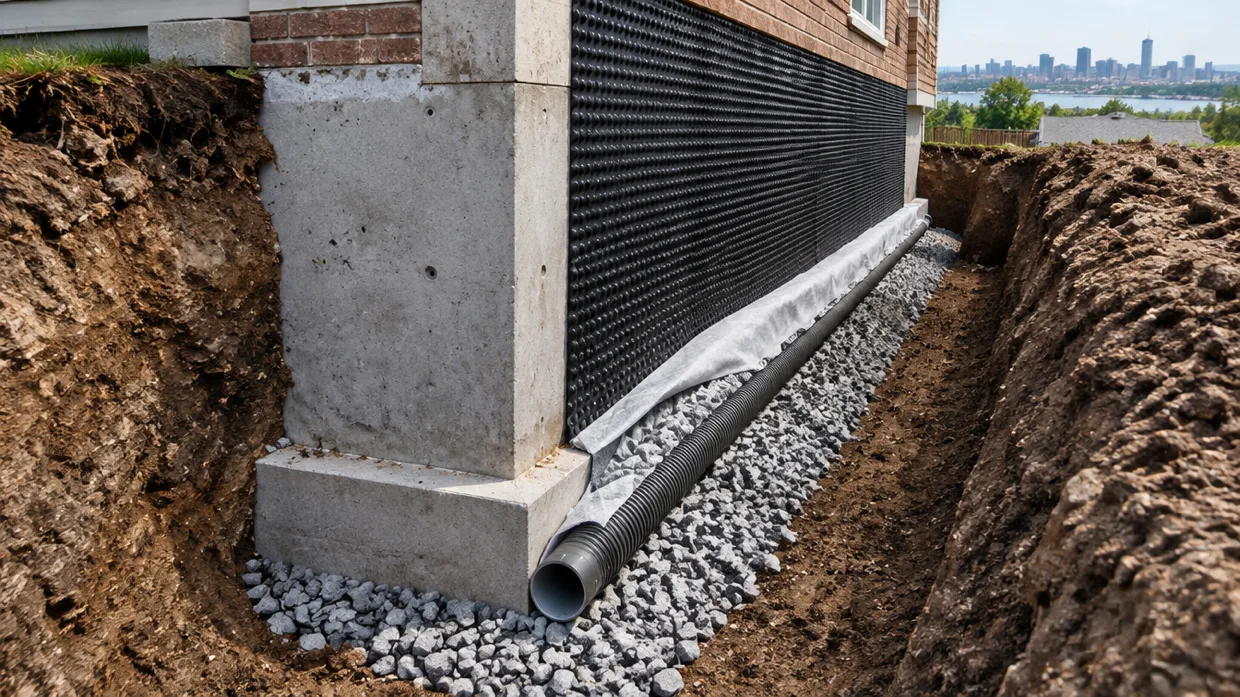
Homes built before the 1970s in Hamilton commonly have clay weeping tile, laid in short rigid segments with open joints between each piece rather than one continuous perforated run. Those joints are both the original drainage point and the system's biggest weakness, since root intrusion and sediment buildup both concentrate exactly where the segments meet.
| Factor | Clay Weeping Tile | Modern Perforated Pipe |
|---|---|---|
| Material | Rigid clay segments, open joints | Continuous perforated PVC, filter fabric wrap |
| Common install era | Pre-1970s Hamilton homes | Current Ontario Building Code standard |
| Main failure mode | Root intrusion and sediment at joints | Rare; fabric wrap blocks most sediment |
| Typical service life | Already decades past original installation | 25+ years with proper installation |
| Replacement urgency | Higher once any failure signs appear | Lower; monitor rather than replace proactively |
Modern perforated pipe wrapped in filter fabric solves both failure modes at once: the continuous run has no joints for roots to target, and the fabric wrap blocks the fine sediment that clogs older systems over time. On a home still running original clay tile, replacement is less a question of if than when, which is why a failed section is often treated as a signal to assess the full run rather than patch one spot in isolation.
How Weeping Tile Connects to Your Sump Pump
Weeping tile and a sump pump are two halves of the same system, not separate purchases. The tile collects water and channels it to a low point, the sump pit, where the pump takes over and pushes that water out through a discharge line away from the foundation. Replacing weeping tile without confirming the sump pump and pit can actually handle the flow the new, unclogged system now delivers is a common gap, since a system that was clogged for years may have been sending far less water to the pump than a fully functioning one will.
For that reason, a sump pump and pit are usually priced as part of the same weeping tile project rather than billed separately later, since confirming pump capacity against the newly restored drainage volume is part of doing the job correctly the first time.
What a Site Assessment Actually Confirms
A site assessment confirms the real condition of the existing weeping tile rather than guessing from symptoms alone. A camera inspection run through an accessible cleanout or the sump pit can show exactly where a clog, collapse, or root intrusion is located, which sometimes means only a section needs replacing rather than the full perimeter. Without that inspection, a quote is a worst-case estimate rather than a number based on what is actually happening underground.
The same visit maps out site access around the full foundation, flagging anything that will add labour: an attached deck, mature trees close to the foundation line, a narrow side yard between properties, or existing hardscaping that needs to be removed and reinstated. These details are specific to each property and are exactly why a fixed-price quote only follows a site visit rather than being given over the phone from a square footage number alone.
Where the inspection shows a localized failure rather than a system-wide one, a partial exterior dig at just the failed section, paired with an interior drainage channel for the rest of the perimeter, can sometimes solve the problem for less than a full exterior replacement would cost, while still addressing the actual point of failure directly.
Quick Checklist Before You Call
Frequently Asked Questions
Weeping tile is a perforated pipe along the base of the foundation footing that collects groundwater before it can press against the foundation wall, routing it to a sump pit instead.
Recurring basement dampness, water stains along the base of the walls, or a sump pump that never seems to cycle are common signs that the original weeping tile has clogged or collapsed.
Exterior replacement excavates around the foundation and replaces the tile at the footing, which is more invasive but addresses the source. Interior replacement installs a drainage channel along the inside basement floor perimeter, which is faster and less disruptive.
Homes built before the 1970s commonly used short clay pipe segments, which shift and clog with roots and sediment over decades. Modern perforated PVC pipe wrapped in filter fabric lasts significantly longer.
A sump pump and pit are usually part of the same project, since weeping tile needs somewhere to send the water it collects.