Almost every Hamilton basement gets a wall crack sooner or later - the question is never whether one shows up, it's whether it actually means something. Hamilton sits on lakebed clay that swells and shrinks with the seasons, and freeze-thaw cycles hit multiple times most winters, so basement walls are under near-constant, variable pressure. This guide walks through what's normal shrinkage, what's a real warning sign, and how to tell the difference before you either panic over nothing or ignore something that genuinely needed attention months ago.
Why Hamilton Basements Crack
Three forces drive most of what we see on service calls across the city. Hamilton's lakebed clay soil expands when saturated and contracts as it dries, exerting variable pressure on basement walls year-round. Freeze-thaw cycles - often several per winter - force water into any existing hairline opening and widen it a little more each time it freezes. And hydrostatic pressure from groundwater and imperfect drainage pushes against basement walls from the exterior, especially through spring melt and heavy rain.
Most cracks actually show up within a home's first 10 years, as the poured concrete works through its long-term curing and shrinkage cycle - that's a separate, usually low-risk process from the freeze-thaw and hydrostatic forces that come later. The two can look similar on a wall, which is exactly why they get confused.
A pattern worth knowing: a hairline crack at year 5 can easily be a leaking crack by year 15 if it's never sealed. Cosmetic today doesn't mean cosmetic forever.
What's Normal, What's Not
Usually Cosmetic
Hairline vertical cracks in poured concrete, under 2mm wide, with no lateral offset and no moisture present - typically shrinkage cracks from the concrete's original cure.
Usually Structural
Horizontal cracks (always a concern - lateral soil pressure bending the wall), stair-step cracks in block walls (settlement), or any crack over 3mm wide with lateral offset.
Those are indicators, not a diagnosis. For a full breakdown of repair methods and pricing, see our basement crack repair service page.
Five Warning Signs Worth a Closer Look
- Water or moisture along the crack - consistent water at the same spot means hydrostatic pressure is actively driving it through
- White mineral deposits (efflorescence) - those chalky white streaks confirm water has moved through the crack repeatedly, even if it looks dry today
- A crack that has grown - if a pencil mark across the crack no longer lines up, it's actively moving
- Musty smell or mold near the crack - confirms moisture has been present long enough to matter
- Width over 3mm, or lateral offset - points to structural movement beyond simple shrinkage
Epoxy vs. Polyurethane Injection
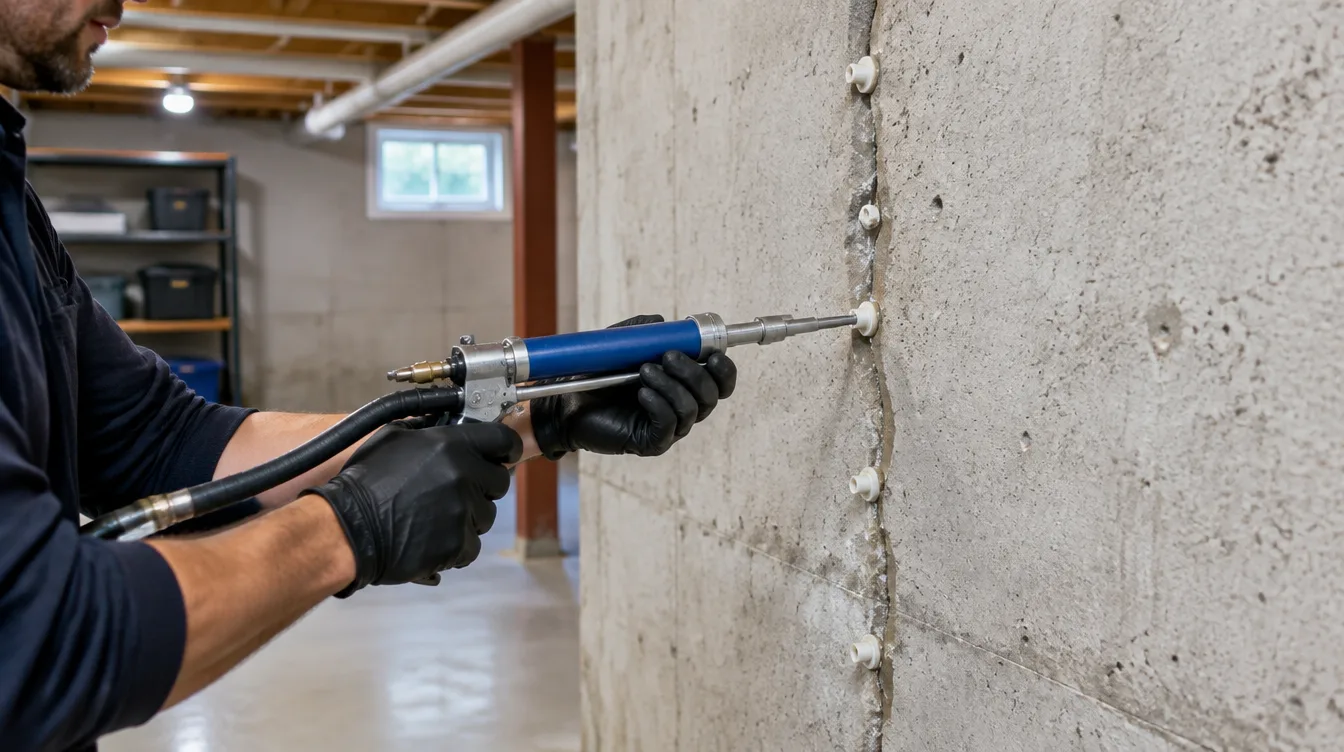
Once a crack needs more than monitoring, the repair method depends on what the crack is doing. Epoxy injection is used for dry, non-moving structural cracks and cures rigid - effectively welding the concrete back together at the crack line. Polyurethane foam injection is used for active leaks: it expands and cures on contact with moisture, staying slightly flexible afterward so it can absorb minor seasonal movement without reopening a leak path. Both go in at low pressure through ports installed directly along the crack, filling it from the interior wall face through to the exterior - not a surface patch pretending to be a fix.
What the Repair Process Actually Looks Like
Most of this work happens entirely from the interior, with no excavation and nothing disturbed outside. A typical appointment runs through four steps: port installation along the crack length, surface sealing between the ports, low-pressure injection with the epoxy or polyurethane material, and cleanup. Port installation, sealing, injection, and cleanup usually fit into a single-day appointment - 2 to 5 hours depending on crack length and how many cracks are being addressed. The injected material fully cures in 24 to 48 hours, after which the wall is permanently sealed at that location and ready to be painted or finished over if you're planning to finish the basement.
What Basement Crack Repair Costs in Hamilton
$500 - $900: Dry Shrinkage Crack
Hairline up to 2mm, under 24 inches, no moisture or offset - a single epoxy injection port set, done same-day.
$800 - $2,000: Wet or Leaking Crack
Active moisture or intermittent leaking, handled with polyurethane foam injection from interior access only - no excavation required.
$1,500 - $3,500: Multiple Cracks
Two or more cracks handled in one appointment, with combined pricing since it's a single mobilization.
Horizontal, wide, or offset cracks that need a structural assessment first are quoted after that inspection, and may include a reinforcement recommendation alongside the crack repair itself. Every job starts with an honest read on what the crack actually means - you won't get sold a $4,000 repair for something that needs $600 of injection.
Common Myths About Basement Cracks
A few beliefs come up on nearly every basement crack call, and they're worth correcting before they cost a homeowner money or peace of mind - some lead to overspending, others to ignoring something that actually needed a repair months earlier:
- "Any crack means my foundation is failing." Most cracks are shrinkage-related and cosmetic. Reacting to every hairline crack as an emergency leads to overpaying for work that isn't needed.
- "If it's not leaking, it's fine." A dry crack can still be structurally significant if it's wide, horizontal, or offset - moisture and structural risk are two separate questions, not one.
- "Painting or sealing the surface fixes it." Surface products can hide a crack temporarily but don't stop the movement or pressure behind it - the crack, or a new one nearby, typically returns.
- "All injection repairs are the same." Epoxy and polyurethane serve different purposes, and using the wrong one - rigid epoxy on an actively leaking crack, for example - can fail faster than doing nothing at all.
Reducing Future Crack Risk
While cracks from concrete curing can't really be prevented, the freeze-thaw and hydrostatic pressure that widen existing cracks over time can be managed. Keeping gutters clean and downspouts extended away from the foundation reduces the water reaching the soil against your basement walls. Grading that slopes away from the house, rather than toward it, does the same. Homes with an already-failing sump pump or no interior drainage system tend to see cracks reopen faster after a repair, since the underlying hydrostatic pressure never actually went down - something worth mentioning to whoever assesses your crack, since it can change what gets recommended alongside the injection itself, sometimes at no extra cost.
When to Call Instead of Monitor
See how this plays out on a real Hamilton project in our Kirkendall case study, or go straight to what a free assessment covers if you're ready to get a number for your own wall.
Frequently Asked Questions
Hamilton's lakebed clay soil swells when wet and shrinks when dry, exerting variable pressure on basement walls year-round. Freeze-thaw cycles - often multiple per winter - force water into existing hairline cracks and widen them each season. Hydrostatic pressure from groundwater pushes against walls from the exterior. Most Hamilton basement cracks trace back to one or more of these ongoing forces.
Horizontal cracks are always a structural concern - they mean lateral soil pressure is bending the wall. Stair-step cracks in block walls indicate settlement. Cracks wider than 3mm with lateral offset are structural. Hairline vertical cracks in poured concrete with no offset and no moisture are typically cosmetic shrinkage cracks.
DIY crack sealants and hydraulic cement usually only address the visible surface, not the crack's full depth. Surface-only repairs fail once underlying movement continues or hydrostatic pressure builds behind the sealed face. Proper repair uses low-pressure injection to fill the crack completely from interior to exterior wall face.
Epoxy injection is used for dry, non-moving structural cracks and cures rigid, effectively welding the concrete back together. Polyurethane foam injection is used for active leaks - it expands and cures on contact with moisture, staying slightly flexible afterward to absorb minor seasonal movement without reopening a leak path.
Most injection appointments are completed in a single day. Port installation, surface sealing, injection, and cleanup typically take 2 to 5 hours depending on crack length and how many cracks are being addressed. The injected material fully cures in 24 to 48 hours.