An Eastmount homeowner called about one crack and ended up needing two different repair materials for two different problems on the same foundation wall. This is a walkthrough of how the assessment told the two cracks apart, why epoxy was right for one and polyurethane for the other, and what the combined repair looked like.
The Problem
The homeowner noticed a vertical crack near the basement's rear corner and called for an assessment, expecting a single straightforward injection repair. The crack ran roughly two feet from floor to a point partway up the wall, thin but visually noticeable against the otherwise unmarked concrete, and had prompted enough concern that the homeowner had been meaning to call for several weeks before finally booking the assessment.
During the on-site visit, our project manager found a second crack roughly twelve feet away, on an adjacent wall section, that the homeowner hadn't flagged - a shorter, less visually obvious crack that had been quietly present for at least a year based on the homeowner's recollection, but had never been formally assessed. It sat partially behind a stack of storage shelving, which likely explains why it had gone unnoticed for so long despite the visible staining around it once the shelving was moved aside for the inspection.
Two cracks, two different conditions: the original crack the homeowner called about was bone dry with no history of moisture. The second, previously unreported crack showed active efflorescence and dampness - a completely different repair problem requiring a different material.
The Diagnostic Assessment
The rear corner crack the homeowner had called about was confirmed dry, with no staining or efflorescence anywhere along its length, and the homeowner confirmed it had never shown signs of dampness even during heavy rain. That made it a clean epoxy candidate - the priority was restoring structural bond, not managing water. The second crack, on the adjacent wall, told a different story: visible white efflorescence staining along its length and a faint dampness to the touch even on a dry day, with the homeowner recalling occasional visible wetness near that spot after significant rain they'd previously attributed to "just how old basements are."
Crack One: Epoxy
Dry, stable, no history of water. Epoxy injection restored structural bond across the full depth of the crack.
Crack Two: Polyurethane
Active moisture and efflorescence staining. Polyurethane's water-reactive expansion sealed the crack against future water entry.
The Work
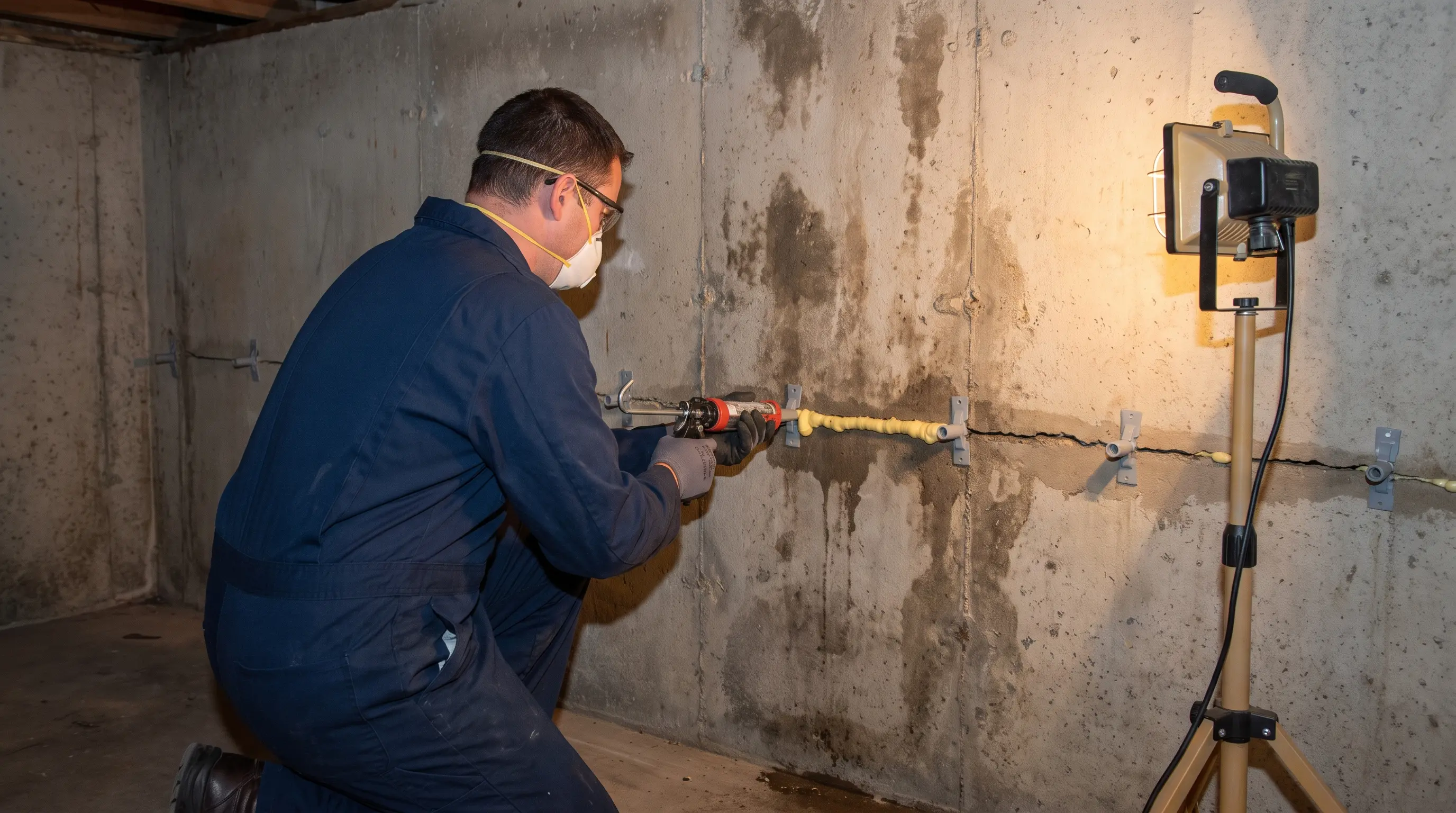
Both cracks were injected in the same half-day visit. For the dry rear-corner crack, injection ports were set along its full length and epoxy resin was pumped through each port in sequence from bottom to top, filling the crack through the wall's full depth rather than just sealing the visible surface gap. For the damp second crack, the process was similar but used polyurethane instead - the material's reaction with the crack's existing moisture triggered the expansion that filled the crack and sealed it against further water entry. Both sets of injection ports were ground flush once cured, leaving two thin, largely invisible repair lines on a wall that previously had one acknowledged problem and one unacknowledged one.
The order of operations mattered slightly: the technician worked on the polyurethane crack first, since its active moisture meant timing was less flexible, then moved to the dry epoxy crack once that was complete. Both cracks were fully injected and their surface ports ground flush before the technician left the site, so the homeowner had a single finished visit rather than a repair spread across two separate appointments.
Timeline From Call to Both Cracks Sealed
The homeowner called after noticing the rear-corner crack during a routine basement cleanup, with no urgency beyond general curiosity about whether it needed attention. The free assessment was booked within the same week, and because the scope was a straightforward injection repair with no permit requirement, a written proposal covering both cracks went out the same day as the visit, once the second crack had been identified and assessed. The homeowner approved it within a couple of days, and the injection work itself - both cracks, both materials - was scheduled and completed in a single half-day visit about a week and a half after the initial call. Total time from first call to both cracks sealed: just under three weeks, almost entirely scheduling lead time rather than actual work.
What This Project Confirms About Full-Wall Assessments
The core lesson here isn't really about epoxy versus polyurethane specifically - it's about what a proper, thorough assessment catches that a homeowner's own casual inspection often doesn't. The second crack had been present long enough that the homeowner had developed a kind of blindness to it, mentally filing it under "just an old basement thing" rather than something worth a professional look. That's an extremely common pattern: homeowners tend to notice and act on the crack that looks the most dramatic or the most recently changed, while a quieter, slower-developing crack nearby goes unmentioned simply because it's been there long enough to stop registering as unusual.
Since this project, our project managers have made a habit of explicitly walking the full accessible foundation perimeter on every assessment, not just the specific spot a homeowner points to - a five-minute addition to the visit that, on this project alone, caught a second problem before it had the chance to develop into active water intrusion and meaningful interior damage down the road.
The Result
- Both cracks sealed in a single half-day visit, using the material matched to each crack's actual condition
- The previously unreported second crack, now caught and sealed before it worsened
- No further water entry at either location through the following rainy season
- Structural bond restored at the dry crack, water sealed out at the damp one
This project is a clean example of why a full-wall assessment matters even when a homeowner calls about one specific, visible problem - the crack that actually needed the most attention wasn't the one that prompted the call, and it would have gone unaddressed indefinitely behind that shelving unit otherwise. For the full comparison of when each material applies, see our epoxy vs polyurethane guide, for service details on a project like this, visit our foundation repair service page, and if you're ready to get your own foundation assessed, our free estimate guide covers what that visit includes.
Why a Full-Wall Assessment Matters in Neighbourhoods Like Eastmount
Eastmount sits on Hamilton's east mountain brow, developed mostly through the 1950s and 60s with a mix of bungalows and side-splits on poured-concrete foundations of that era. Homes here are old enough that multiple, unrelated cracks on the same foundation are common - not because the whole wall is failing, but because decades of ordinary concrete curing, shrinkage, and minor settling produce isolated cracks at different points and different times, each with its own cause and condition. It's exactly why our assessments walk the full accessible perimeter rather than stopping at the one crack a homeowner called about - a second, unreported crack is common enough on homes of this era that checking for it is now standard practice on every Eastmount assessment.
Frequently Asked Questions
The home had two separate cracks in different conditions - one dry and stable, ideal for epoxy's structural bond, and one actively seeping after rain, which needed polyurethane's water-reactive seal. Using the same material on both would have meant a compromised repair on at least one of them.
A physical inspection during a dry period confirmed one crack showed no moisture and no history of staining, while the other showed clear efflorescence and dampness consistent with repeated water entry - a visual and tactile diagnosis backed by asking the homeowners about the crack's behaviour during past rain events.
Yes - both injections were completed in a single half-day visit, since the materials and injection process for each crack, while different, don't require separate site visits or significant additional time.