Foundation repair in Hamilton costs anywhere from $500 for a single crack injection to $90,000 for full perimeter underpinning, and the honest answer to "what will mine cost" depends entirely on what your specific foundation is actually doing. This guide covers every repair method, what each one costs, the warning signs that tell you which category your problem falls into, and why waiting rarely saves money - plus what actually causes these problems in Hamilton specifically and why a DIY fix usually doesn't hold.
Warning Signs Worth an Assessment
A handful of signs consistently separate a foundation that needs professional attention from one that's fine to monitor. Horizontal or stair-step cracks in a foundation wall are always a structural concern - they indicate lateral soil pressure or settlement, not simple shrinkage. Any crack wider than 3mm, especially with visible offset between the two sides, points the same direction. Walls that visibly bow or lean inward are a clear sign of ongoing pressure the foundation is struggling to resist. Doors and windows that stick or no longer close properly, and floors that slope or bounce underfoot, often trace back to a foundation that's shifted enough to throw the whole structure slightly out of square. Water that consistently enters at the same wall location, rain after rain, points to an entry path that needs sealing regardless of whether it's also a structural issue.
Any single sign on this list is worth a call. Multiple signs together, especially combinations like a bowing wall plus sticking doors, usually mean active structural movement that's past the point of simple monitoring.
The Four Repair Methods, by Severity
Crack Injection - Least Severe
Epoxy or polyurethane injection into isolated cracks in poured concrete walls, priced per crack. Addresses cracks that are sealed shut but not actively compromising the wall's structural integrity.
Wall Stabilization - Moderate
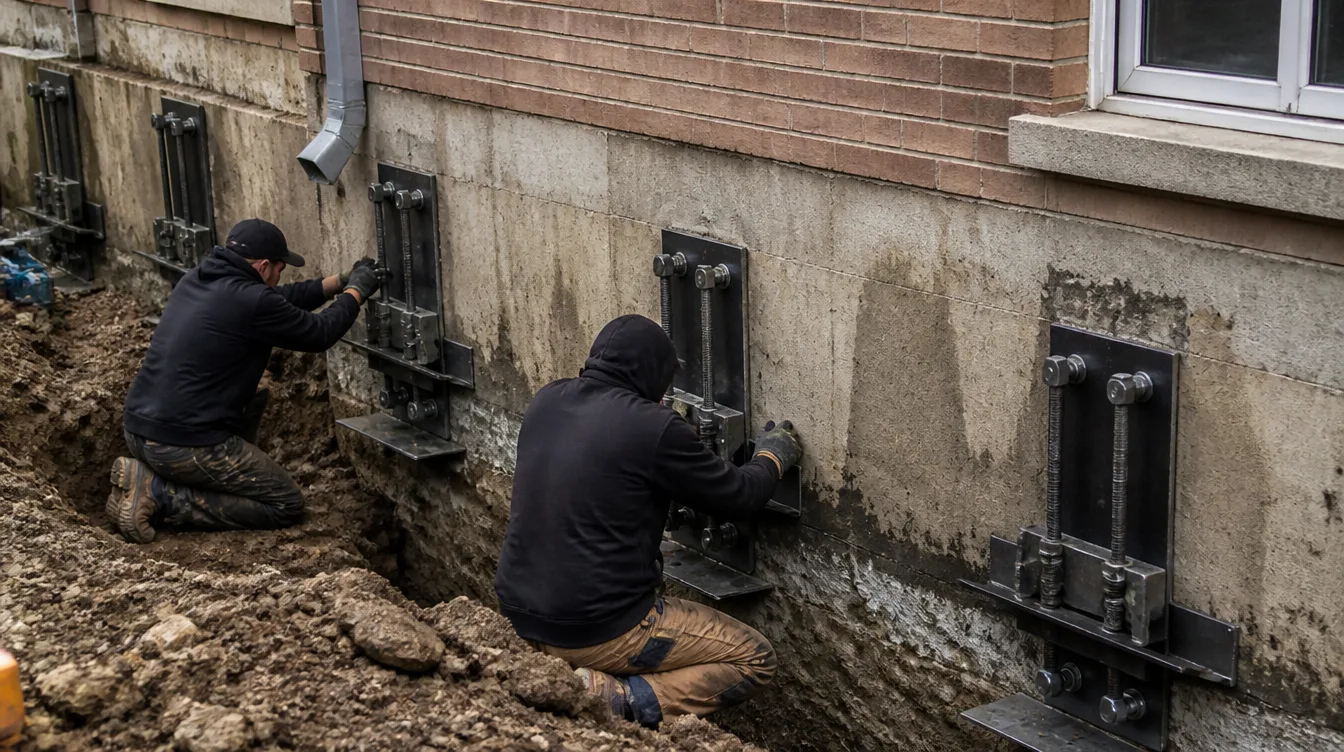
Carbon fibre straps or steel anchor rods installed to stop a bowing or leaning wall from moving further, priced against wall length and how many reinforcement points are needed.
Partial Underpinning - Significant
Underpinning limited to one or two sides of the foundation, where settlement is localized rather than affecting the full perimeter. Permits and engineering included.
Full Perimeter Underpinning - Most Severe
The complete fix for active settlement affecting the entire foundation perimeter - permits, engineering, waterproofing, and a new slab all included.
Full method and pricing details live on our foundation repair service page.
The Full Cost Breakdown
$500 - $2,000: Crack Injection
Priced per crack, usually completed same-day, with the material chosen based on whether the crack is dry or actively leaking.
$3,000 - $8,000: Wall Stabilization
Carbon fibre straps or steel anchors for a bowing or leaning wall, scaled to wall length and severity.
$8,000 - $20,000: Partial Underpinning
Underpinning localized to the affected side or sides, rather than the full perimeter.
$45,000 - $90,000: Full Perimeter Underpinning
Complete structural rebuild of the foundation perimeter for active, widespread settlement.
Pricing spans this wide a range because the underlying problems do too - the right number depends entirely on what your specific foundation actually needs, which only an on-site assessment can confirm.
Why Waiting Almost Always Costs More
Most foundation problems in Hamilton homes worsen over time if left unaddressed. Freeze-thaw cycles, clay-heavy soil, and groundwater movement all apply ongoing pressure to foundations year-round, not just during obviously wet or cold periods. A crack that measures 2mm today can measure 8mm in three years - and the repair category it falls into can shift from a $600 injection to a multi-thousand-dollar stabilization project in that same window. Early intervention is consistently less expensive than deferred repair, precisely because most foundation problems don't stay the same size while you decide whether to act.
This pattern shows up repeatedly in the projects we take on: a homeowner calls about a crack they first noticed years earlier, assuming it's been stable the whole time simply because nothing dramatic happened. In reality, slow structural movement rarely announces itself with a dramatic event - it shows up as a crack that's quietly widened, a door that's gradually started sticking, or a wall that's leaned just slightly more each year. None of those changes are obvious week to week, which is exactly why they go unaddressed for so long.
What Actually Causes Foundation Problems in Hamilton
Three forces drive the overwhelming majority of foundation calls across the city. Hamilton's lakebed clay soil expands when saturated and contracts as it dries, exerting cyclical pressure on foundation walls that most soil types don't produce to the same degree. Freeze-thaw cycles, often several per winter, force water into any existing crack or gap and widen it incrementally each time it freezes and expands. And groundwater movement - particularly during spring melt and after heavy rain - creates hydrostatic pressure that pushes against foundation walls from the exterior, finding the weakest point in the wall to exploit.
Older homes face an additional factor: original construction standards, weeping tile materials, and drainage systems from decades ago simply don't meet what's considered adequate today. A foundation built to 1960s standards was engineered for the expectations of its era, and it's common for problems to surface now specifically because the systems designed to manage water and soil pressure have degraded or were undersized from the start relative to what we know today about Hamilton's soil conditions. Newer homes aren't immune either - modern construction reduces but doesn't eliminate the underlying soil and climate forces at work across the city, and even a well-built foundation can develop problems if grading settles or a drainage component fails years after construction.
Why DIY Fixes Rarely Solve the Real Problem
Hardware store crack sealants and DIY waterproofing paints address the visible symptom without touching the underlying cause. A sealant applied to the surface of a crack can look like a complete fix while the crack's interior remains open and the pressure or movement causing it continues unaddressed - the seal typically fails within a season or two, sometimes reopening worse than before. For a bowing wall, there's no DIY equivalent at all; carbon fibre or steel anchor reinforcement requires structural calculation specific to the wall's height, span, and the load it's actually resisting, which isn't something a homeowner can safely estimate without an engineer's input. The honest risk of DIY foundation work isn't just that it might not work - it's that it can mask a worsening problem behind a surface fix that looks fine until it very suddenly isn't.
Permits and Timeline
See how this played out on a real project in our Strathcona case study, or go straight to what a free assessment covers if you're seeing any of these warning signs yourself.
Frequently Asked Questions
Signs include horizontal or stair-step cracks in foundation walls, cracks wider than 3mm, walls that bow or lean inward, doors and windows that no longer open or close properly, sloping or bouncing floors above the basement, and water consistently entering at the same wall location.
Crack injection repairs run $500 to $2,000 per crack. Wall stabilization with carbon fibre straps runs $3,000 to $8,000. Partial underpinning runs $8,000 to $20,000. Full perimeter underpinning for active settlement runs $45,000 to $90,000.
Yes - most foundation problems in Hamilton homes worsen over time if left unaddressed. Freeze-thaw cycles, clay-heavy soil, and groundwater movement all apply ongoing pressure. A crack that's 2mm today can be 8mm in three years. Early intervention is always less expensive than deferred repair.
It depends on scope. Crack injection and surface sealing typically don't require permits. Underpinning, wall anchors, and structural reinforcement work does require a City of Hamilton building permit and engineer-stamped drawings.