Most Hamilton homeowners who end up needing underpinning didn't wake up one day and decide to look for it - they noticed a crack, a sloping floor, or a basement that felt more "off" than usual, and started asking questions. This guide walks through the specific warning signs that mean your foundation may need underpinning, so you know what to watch for and when a sign is genuinely worth acting on versus simply monitoring over time.
Cracks: What Type and Direction Actually Mean
Not all foundation cracks are equal, and the distinction matters more than most homeowners realize. Vertical hairline cracks under roughly 1/16 inch, especially near window corners or where two pours meet, are common in poured concrete and usually just curing shrinkage - cosmetic, not structural. Horizontal cracks running along a wall, by contrast, suggest the wall is being pushed inward by soil or hydrostatic pressure - a genuine structural concern. Stair-step cracks in block or brick foundations, following the mortar joints in a diagonal pattern, typically indicate differential settlement - one section of the foundation moving at a different rate than the rest, which is precisely the kind of movement underpinning is designed to stop.
The test that matters most: is it changing? A crack that's been the exact same width for ten years is a different situation than one that's visibly wider than it was six months ago. Mark it, date it, and check back - active growth is the clearest single signal that something needs attention.
Low Ceilings and Sloping Floors
Ceiling Height Under 6'5"
Ontario Building Code requires 6'5" clear height for a basement to count as legal living space. Many Hamilton homes built before the 1960s have basements well under that, built purely for storage and mechanicals.
A Main Floor That's Developed a Slope
A noticeably sloped or bouncy main floor, doors that no longer close square, or gaps opening up between floor and baseboard can all trace back to uneven foundation settlement below.
Why Hamilton Foundations Show These Signs More Than Most
Several factors specific to Hamilton make foundation warning signs more common here than in many other Ontario cities. The city's housing stock skews old - large swaths of Westdale, Corktown, Crown Point, and Kirkendall were built between 1900 and 1950, on foundations built to the standards, materials, and soil-bearing assumptions of their era, not today's. Clay-heavy soil across much of the city expands and contracts with moisture more than sandier soils elsewhere, applying cyclical pressure against foundation walls that can accelerate settlement over decades. And the escarpment itself creates localized variation in soil composition and drainage patterns that a generic foundation inspection checklist doesn't always account for - which is part of why a Hamilton-specific structural assessment matters more here than it might in a newer, more uniform subdivision built on consistent engineered fill.
None of this means every older Hamilton home needs underpinning - plenty of century homes have foundations in genuinely good structural condition. It does mean that when warning signs do show up, they're rarely isolated incidents; they're often symptoms of decades-old construction meeting decades of the same clay-heavy soil doing what clay-heavy soil does. That context is exactly why a proper assessment traces the actual cause rather than treating every crack as the same problem with the same fix.
Other Signs Worth Watching For
Beyond cracks and ceiling height, a handful of other patterns are worth flagging during any basement walkthrough. Doors and windows that have started sticking or no longer latch properly, especially on an upper floor, can indicate the frame has shifted as the structure below has moved. Gaps appearing between interior walls and ceilings, or between a chimney and the house it's attached to, point the same direction. And a basement that's noticeably damper than it used to be, even without an obvious active leak, sometimes signals that settling has opened up new pathways for water that weren't there when the foundation was built.
None of these signs alone is a certain diagnosis - they're indicators that warrant a proper structural look, not a DIY verdict. Full detail on the underpinning process itself is on our basement underpinning service page.
How to Track a Sign Before You Book an Assessment
If you've noticed a crack or a subtle change but aren't sure it's urgent, a simple monitoring habit is more useful than either ignoring it or panicking about it. Mark both ends of a crack with a pencil line and the date, and photograph it against a tape measure or ruler for scale every month or two. A crack that hasn't moved in six months of consistent tracking is a very different situation than one that's visibly widened in that same window. The same approach works for a sloping floor - a level placed at a few fixed points, photographed and dated, turns a vague impression of "it feels off" into an actual measurement you can compare over time.
This kind of tracking isn't a substitute for a professional assessment, but it does two useful things: it gives you real, documented information to bring to that assessment, and it helps you tell the difference between a sign worth watching casually and one worth calling about sooner rather than later. If you're ever unsure which category your situation falls into, the free assessment itself is the fastest way to get a definitive answer - there's no cost to finding out, and no obligation once you do.
What Happens After You Spot a Warning Sign
The right next step after noticing a concerning sign isn't demolition or immediate excavation - it's a structural assessment. A project manager inspects the specific crack, slope, or symptom you've flagged, checks the foundation's construction type and overall condition, and determines whether it's isolated and cosmetic, a candidate for a simpler fix like crack injection, or evidence of active settlement that calls for underpinning. That assessment is free and carries no obligation, and it's the only reliable way to move from "something looks off" to an actual, documented understanding of what your foundation needs.
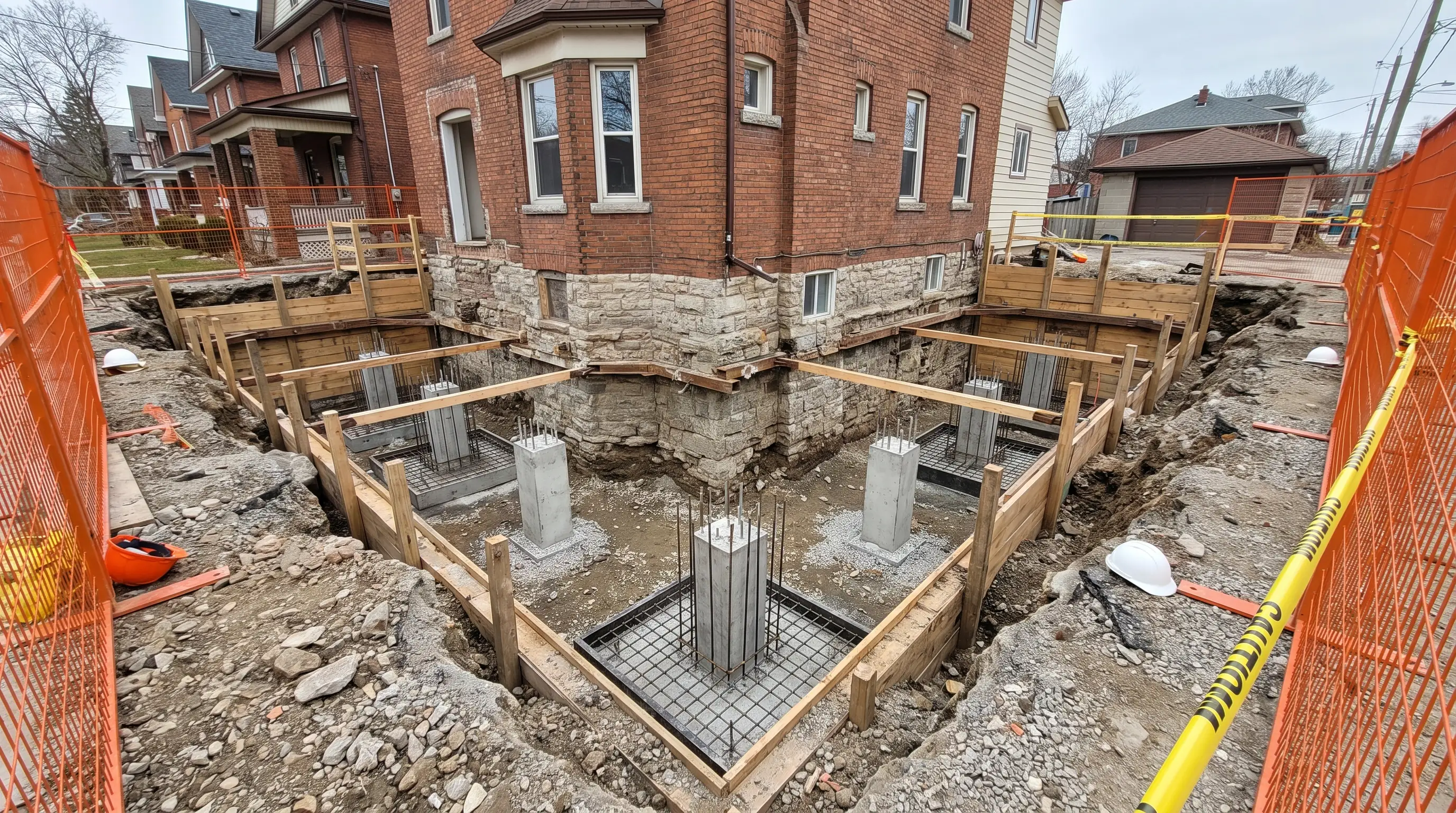
If underpinning does turn out to be the right call, it happens in small, sequenced sections around the perimeter - never all at once - with each section fully cured and inspected by the city before the next one opens. That phased approach is what keeps the structure above fully supported throughout the project, and it's worth understanding before the topic ever becomes urgent, so the process itself doesn't feel unfamiliar or alarming if you do end up genuinely needing it done.
When to Book an Assessment
For a real example of what these signs looked like on an actual Hamilton home - and how they turned out to connect to a much larger underlying issue than the homeowners initially suspected - see our case study, and if you're ready to get your own foundation assessed, our free estimate guide covers exactly what that visit includes and what happens next.
Frequently Asked Questions
Hairline vertical cracks under about 1/16 inch that aren't growing are common and usually cosmetic. Horizontal cracks, stair-step cracks in block or brick, or any crack that's visibly widening over weeks or months point to active structural movement - the kind underpinning is built to address.
You can, but the underlying movement usually doesn't pause while you wait, and the repair scope - and cost - tends to grow the longer active settlement continues unaddressed. A free assessment now costs nothing and tells you whether your specific signs are urgent or can reasonably wait.
Not necessarily - some signs point toward simpler fixes like crack injection or grading correction. That's exactly why a proper structural assessment matters: it distinguishes between a cosmetic issue and one that actually requires extending your foundation's bearing depth.