Spring is the season Hamilton basements are most likely to flood, and the reason is specific: rapid snowmelt hits ground that's still partially frozen and can't absorb it. That combination sends more water toward foundation walls in March and April than any other time of year, more consistently than any other Hamilton weather pattern. This guide covers why it happens, the warning signs worth checking before melt season, and the prevention methods that actually work.
Why Spring Is Different From Any Other Season
Heavy summer rain soaks into ground that's actively absorbing and draining. Spring melt is a different mechanism entirely: the top layers of soil thaw and become saturated while the subsoil beneath can still be partially frozen, creating an impermeable layer that meltwater simply can't pass through. With nowhere to drain downward, that water runs laterally across the surface and pools wherever grading, gutters, or an aging foundation gives it an opening - very often right at the base of a basement wall. A fast melt after a heavy snow year concentrates weeks' worth of accumulated snowpack into a matter of days, overwhelming drainage systems that would handle an equivalent summer rainfall without issue. A rapid temperature swing - several consecutive days above freezing following a deep winter freeze - is the specific weather pattern that produces the worst outcomes, since it compresses an entire season's snowpack into a melt event measured in days rather than the gradual weeks-long thaw a more typical spring produces. Hamilton's location on the escarpment adds another layer: runoff from higher ground above the escarpment face funnels down toward lower-lying neighbourhoods, meaning a home's flood risk depends partly on its position relative to the broader watershed, not just its own lot grading.
The timing problem: by the time standing water actually appears in a basement during spring melt, the underlying drainage failure has usually been developing for months or years - the flood is the symptom showing up at the worst possible moment, not a new problem.
Warning Signs to Check Before Melt Season
Efflorescence and Water Staining
White, chalky mineral deposits or dark tide lines on basement walls confirm water has moved through the concrete before, even if the wall looks dry right now.
Grading That Slopes Toward the House
Ground that slopes toward the foundation instead of away from it funnels meltwater directly at the wall - one of the most common, and most fixable, contributing factors.
A sump pump that's never been tested, downspouts that discharge within a few feet of the foundation, and window wells without proper drainage are three more checks worth running before the ground starts thawing. Full detail on waterproofing methods and diagnosis is on our basement waterproofing service page.
What Actually Prevents Spring Flooding
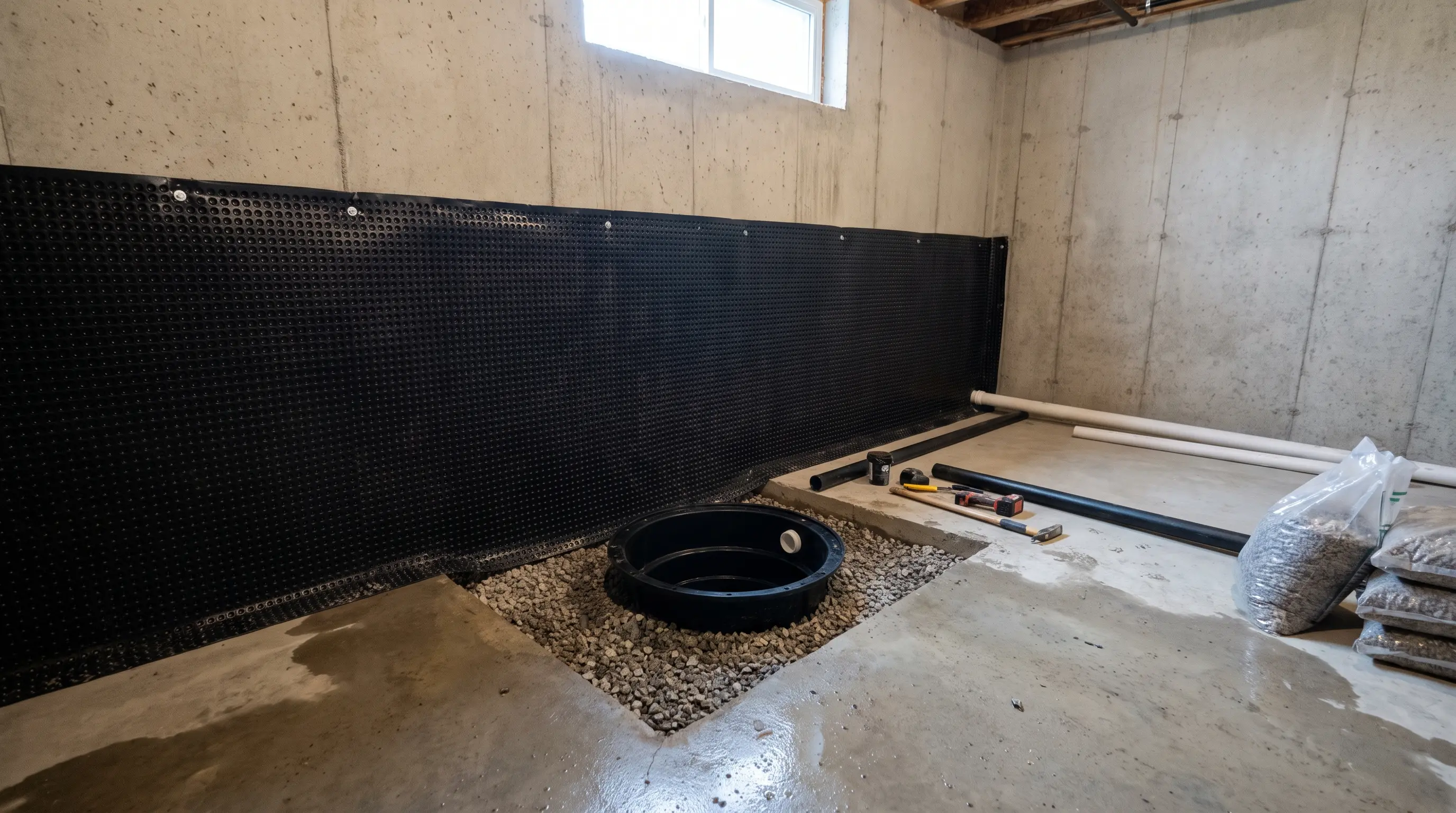
Prevention splits into two tiers. Simple, low-cost corrections - fixing negative grading, extending downspouts at least six feet from the foundation, clearing gutters before the first thaw, and installing a battery backup for an existing sump pump - meaningfully reduce risk on a home with otherwise sound drainage and no active entry points. For a foundation with failed or absent weeping tile, active cracks, or a history of repeat flooding, those surface-level fixes won't address the underlying cause, and the real prevention is a proper interior drainage system, exterior waterproofing, or crack repair matched to the specific entry point a professional assessment identifies.
The mistake we see most often is homeowners investing in the low-cost fixes year after year, treating each spring's flood as a fresh, unrelated event, when a single properly diagnosed and repaired drainage system would have solved the recurring problem permanently. We've met homeowners who have re-graded the same section of yard three separate springs in a row, chasing a symptom that a $10,000 interior drainage system would have eliminated after the first season - money and effort that, in hindsight, would have gone further spent once on the actual fix rather than repeatedly on a partial one.
Why Your Sump Pump Matters More in Spring Than Any Other Season
If your home already has interior drainage and a sump pump, spring is the season that actually tests the system, and it's the season most likely to expose a weakness that's been sitting unnoticed the rest of the year. A pump that's undersized, aging, or hasn't been tested in months is far more likely to fail exactly when the volume of water hitting it spikes during a fast melt - which is also, not coincidentally, one of the more common times for a neighbourhood-wide power outage from a spring storm to knock the pump out entirely at the worst possible moment. A battery backup addresses that specific failure mode: it keeps the pump running through an outage long enough to get through the peak of a melt event, and it's one of the highest-value additions a homeowner with an existing system can make before spring arrives.
Testing a sump pump takes minutes: lift the float switch by hand and confirm the pump activates and moves water through the discharge line without excessive noise or hesitation. Doing this in late winter, before the first real melt, catches a failing pump while there's still time to schedule a replacement rather than discovering the problem in the middle of an active flood.
Grading and Downspouts: The Cheapest Fix With the Biggest Impact
Of every prevention measure available, correcting negative grading around a foundation is consistently the highest-value, lowest-cost fix a homeowner can make themselves. Soil should slope away from the foundation at a minimum grade of roughly 2% for at least six feet - visually, water poured near the wall should visibly run away from the house, not pool or run toward it. Over years, soil settles and compacts unevenly, and what was correctly graded when a home was built can quietly reverse over a decade or two without anyone noticing until a wet spring makes it obvious.
Downspouts discharging within a few feet of the foundation are the other common culprit, effectively funneling roof runoff directly at the wall instead of away from it every time it rains or snow melts off the roof. Extensions that carry discharge at least six feet from the foundation, or ideally to a storm drain or a daylighted point well clear of the house, are inexpensive and can be installed in an afternoon. Neither of these fixes costs more than a modest weekend project, and both meaningfully reduce the water volume actually reaching the foundation before it ever becomes a waterproofing problem.
Signs You Need Professional Waterproofing, Not Just Grading Fixes
For a real example of how spring flooding gets diagnosed and permanently solved, including exactly what the crew found once they traced the water back to its source, see our Chedoke case study, and if you're ready to get ahead of next spring rather than reacting to it again, our free estimate guide covers what that assessment includes.
Frequently Asked Questions
Spring combines rapid snowmelt with saturated, still-thawing ground - the frozen subsoil beneath can't absorb meltwater the way normal soil does, so it runs off toward the path of least resistance, which is often straight at a foundation wall with aging or absent weeping tile.
Sometimes. Correcting negative grading, extending downspouts, and clearing gutters can meaningfully reduce risk on a home with otherwise sound drainage. But once weeping tile has failed or a foundation crack is actively letting water through, grading fixes alone won't solve it.
Booking in fall or winter gives the most scheduling flexibility and the best chance of completing work before the spring melt. Booking in late winter still works but competes with a citywide rush of homeowners doing the same thing, so appointment availability tightens.