For basement crack repair in Hamilton, the first decision is not how to fix a crack but whether it needs fixing yet. A hairline crack that is dry, narrow, and has not changed across a full season can usually be monitored. A crack that is wider than a pencil line, leaking, or visibly growing needs a professional assessment. This guide gives you a decision path: what to check first, when waiting is reasonable, what the repair options look like once waiting stops being reasonable, and why a Hamilton winter matters to the answer.
If you already know a crack needs attention, our basement crack repair page explains how BaseWorks assesses and quotes the work at a fixed price. If you are still deciding, keep reading, because the cheapest correct answer is sometimes to wait and measure.
Hairline vs Structural Cracks: The First Thing to Check
Almost every poured concrete foundation develops fine cracks. Concrete shrinks as it cures, and a vertical hairline crack that appears in the first years after a house is built is usually just that shrinkage releasing stress. These cracks are typically narrower than 1/16 of an inch, run roughly straight up and down, and are dry. On their own they are normally cosmetic.
What separates a hairline crack from a structural one is mostly width, direction, and behaviour. A crack wider than a quarter inch, a crack that runs horizontally along the wall, a stair-step crack following the mortar joints of a block foundation, or a wall that bows inward are different problems, because they point to soil pressure or movement rather than curing. A crack where one side of the wall sits slightly proud of the other (a vertical offset) also deserves a closer look.
If you want the full taxonomy of crack types, our basement wall cracks guide covers how each pattern forms. This post stays focused on the decision: repair now, or watch.
Width alone is not the whole story. A very thin crack that is actively leaking is a water problem today, and a wider crack that has been stable for years may be a lower priority. Direction, moisture, and change over time all count.
When a Crack Is Safe to Monitor Rather Than Repair Now
Monitoring is a legitimate decision, not a way of ignoring the problem. A crack is a reasonable candidate for monitoring when all of the following are true: it is a hairline vertical or slightly diagonal crack, it is dry with no staining or white mineral deposits along it, the wall around it is straight, and there is no sign that it has widened since you first noticed it.
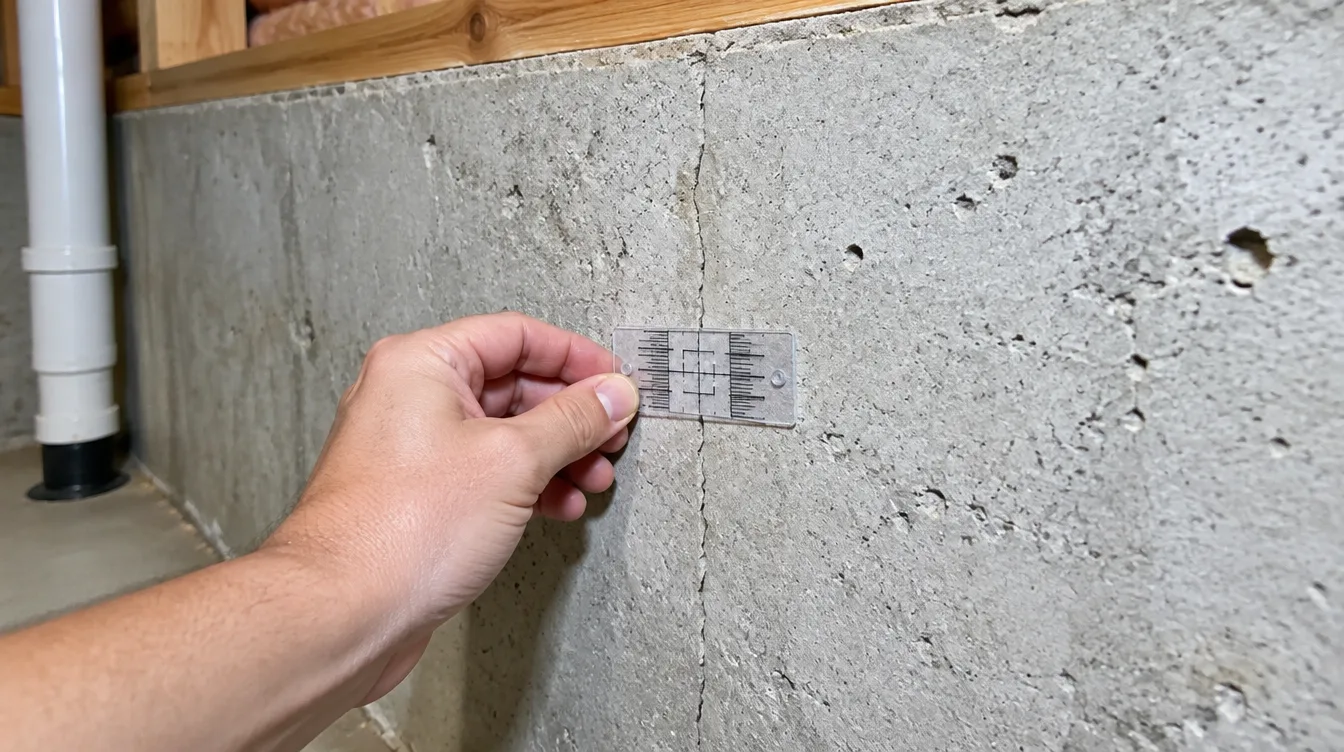
The method is simple and costs almost nothing. Draw a fine pencil line across each end of the crack and write the date beside it. Photograph the crack next to a coin or a small ruler, and take the picture from the same spot each time. A clear plastic crack gauge, the kind with a printed grid, gives a more precise reading and is inexpensive at most hardware stores. Check it every few months and again after the spring thaw and after a heavy rain.
If the crack stays inside your pencil marks, stays dry, and the gauge does not move, the crack is stable and you have a record to prove it. That record is also useful later if you sell the house or ask a contractor for an assessment, since it shows the crack's history instead of leaving everyone to guess.
The moment a crack grows past the marks, starts to seep, or shows new cracks near it, monitoring is over and an assessment is the next step.
What Repair Methods Exist Once a Crack Needs Fixing
When a crack does need repair, the right method depends on what the crack is doing. For most individual vertical cracks in a poured foundation wall, injection from the interior is the standard approach: the crack is cleaned and sealed at the surface, injection ports are set along its length, and material is pumped in so it fills the crack through the full thickness of the wall. No excavation is needed for this type of repair.
The two common injection materials behave differently. Epoxy bonds the two faces of the crack together and restores much of the wall's strength across the crack, which suits a stable crack where structural continuity matters. Polyurethane stays flexible and expands as it reacts with moisture, which suits a crack that leaks or that may move slightly with the seasons. Our epoxy injection crack repair guide walks through the process step by step, and the epoxy versus polyurethane comparison covers how to choose between them.
| What you see | Usual first step | Typical approach |
|---|---|---|
| Dry hairline, unchanged | Mark, photograph, monitor | No repair needed yet |
| Dry crack, wider than a pencil line | Professional assessment | Epoxy injection if stable |
| Leaking or damp crack | Assessment, check drainage | Polyurethane injection, plus drainage review |
| Horizontal, stair-step, or bowing | Structural assessment | Engineered repair, not injection alone |
| Growing past your marks | Assessment soon | Depends on cause found |
Injection treats the crack, not the cause. If water or soil movement is producing the cracking, a good repair also looks at drainage, grading, and any structural movement behind the symptom. That is why an assessment matters before any material is pumped in.
How a Hamilton Clay-Soil Season Affects Crack Behaviour
Much of the Hamilton area sits on clay-rich soil, and clay does not sit still. It swells when it is wet and shrinks as it dries, which means the ground pressing on a foundation wall changes through the year. Add Ontario's freeze-thaw cycle, where water in soil and in cracks freezes, expands, and thaws again, and a crack that looked stable in September can behave differently by March.
This is why a single look is not enough. A crack that is unchanged after one dry month tells you little. A crack that has stayed put through a wet spring, a dry summer, and the first hard frosts of winter tells you a great deal. Where possible, give a hairline crack one full seasonal cycle of monitoring before deciding it is purely cosmetic.
It also explains why leaking cracks often show up in spring and after sudden thaws. Saturated clay holds water against the wall, hydrostatic pressure builds, and water finds the weakest path through the concrete. If a crack only leaks in those conditions, the leak is a clue that exterior drainage deserves attention along with the crack itself. Our guide to when to worry about a foundation crack covers the warning signs that change the urgency.
What Happens If a Crack Is Left Unrepaired
Leaving a stable, dry hairline crack alone usually has no consequence. Leaving a leaking or growing crack alone is different, and the effects tend to build slowly rather than arrive all at once.
Water is the first consequence. A crack that seeps lets moisture into the basement, which can stain finishes, lift flooring adhesives, and leave white efflorescence on the wall as minerals are carried out of the concrete. Persistent dampness in a basement also encourages mould growth, which becomes a health and renovation issue rather than a foundation issue.
The second consequence is the crack itself. Water that enters a crack in winter can freeze, expand, and widen it slightly each cycle, so a small leak can gradually become a larger one. If reinforcing steel is present and exposed to moisture over time, it can also corrode, which weakens the wall further.
The third consequence is practical. If you plan to finish the basement, a crack that has not been addressed is a risk to everything built in front of it. Repairing a crack before drywall and flooring go up costs far less than opening a finished wall later. Anyone planning a basement renovation should have cracks assessed first.
Permits, Assessment, and What a Fixed-Price Visit Covers
Most injection repairs to a single crack do not need a building permit. Repairs that involve structural work, such as stabilizing a bowing wall or repairing the footing, can require engineered drawings and a permit from the City of Hamilton under the Ontario Building Code. A good assessment tells you which category your crack falls into before any price is given.
A BaseWorks assessment looks at the crack's width and direction, whether it is wet or dry, the condition of the wall around it, and the drainage and grading outside. From that, the quote is fixed-price, so the number you are given is the number you pay, and the work is done by our own crews with no subcontractors. For repairs that go beyond a single crack, our foundation crack repair service covers the wider scope.
If the assessment finds a crack that is safe to monitor, we will say so. A clear answer that nothing needs doing yet is still a useful result.
Quick Checklist Before You Call
Frequently Asked Questions
A hairline crack under 1/16 inch that is not leaking and has not changed in width over a season can often be monitored. Anything wider, actively leaking, or growing should be assessed by a professional.
Mark both ends of the crack with a pencil line and the date, then check every few months. Any new growth past the marks means it is active and needs attention.
No. Most hairline cracks come from normal concrete curing shrinkage and are cosmetic. Horizontal cracks, step cracks in block foundations, or cracks wider than a quarter-inch are the ones that signal a structural issue.
Yes, for most individual cracks. Epoxy or polyurethane injection seals the crack from the interior without digging up the exterior.
Water intrusion can worsen efflorescence, promote mould growth, and in the freeze-thaw cycles common to Hamilton winters, slowly widen the crack further.